.svg)

.svg)

.webp)
.webp)

- Ignition Benefits: Best for startups looking to leave expensive, opaque PEOs. It shows you the claims history and employee data your carrier is already using to price your plan, then uses that insight to negotiate better rates
- Rippling or Gusto: Best for teams that want payroll, HR, and benefits in one platform
- Sequoia One or TriNet: Best for growing startups that want more structured PEO support
- Engage PEO or Paychex: Best for businesses that want more hands-on support
Every year, founders open their benefits renewal and see the same thing: higher costs, more confusing plan options, and no clear explanation of what changed.
And in 2026, that pressure is getting worse. Mercer reports that total health benefit cost per employee is expected to rise 6.5% on average in 2026, the highest increase since 2010.
Some of that increase is market-driven. But that doesn’t mean every startup is paying the right price for the risk profile it has.
Behind the scenes, insurance carriers are constantly evaluating your team’s risk. The problem is, most startups never see that data, which makes it hard to know whether the increase is justified or your company is simply overpaying.
The lack of visibility is also one of the reasons many startups turn to professional employer organizations (PEOs).
On paper, a PEO offers a simple answer: bundled HR, payroll, compliance, and benefits in one place. But as startups grow, especially in the 25-200 employee range, that convenience can become expensive. Rising premiums, limited visibility, and less flexibility can turn the PEO from a solution into part of the problem.
If a PEO still feels like the right fit for your stage, here are the best options to consider. Just go in knowing what you may be giving up in cost visibility.
This guide breaks down the best PEOs for startups in 2026, and when it may be time to look for an alternative.
8 Best PEOs for Startups: A Quick Overview
Ignition Benefits: Best for Startups Looking to Leave Expensive PEOs
.webp)
Ignition Benefits is an employee benefits brokerage built for startups that are frustrated with, and want to leave, opaque PEOs. It shows founders how carriers assess their team’s risk, then uses that data to negotiate better rates and help them move to a setup that makes more financial sense.
Unlike platforms that bundle HR, payroll, and benefits into one system, Ignition focuses on one of the biggest cost centers on your P&L: employee benefits.
This focus is shaped by founder Nick Taranto’s experience scaling Plated to 1,500 employees and leading the company through its acquisition by Albertsons, giving him firsthand insight into what benefits misalignment costs at scale.
It’s a strong option for founders researching PEO alternatives for startups or wondering how to leave a PEO without disrupting coverage.
Ignition Benefits Key Features
Here are a few of Ignition Benefits’ standout features.
1. Benefits Risk Score Visibility
The Benefits Risk Score is the internal rating insurers use to assess how risky your team is to cover. Ignition shows founders that score, so it’s easier to understand why costs are rising and whether those increases are actually justified. No need to rely on vague explanations from brokers or PEOs.
2. Renewal Negotiation Using Real Data
Instead of accepting renewal quotes at face value, Ignition uses your risk profile to shop the market and negotiate better pricing. The goal is to keep your coverage strong while reducing premiums, so you aren’t forced into unnecessary trade-offs.
3. PEO Exit Support and Transition Guidance
If you’re stuck in an expensive PEO, Ignition helps you plan and manage to transition out of it. This includes evaluating timing, avoiding coverage gaps, and setting up a more flexible benefits structure outside the PEO model.
Curious to see how much you could save on your current plan?
Contact us today.
Ignition Benefits Pricing
Ignition does not charge employers an out-of-pocket fee for its brokerage service. It is compensated through standard carrier commissions, like traditional benefits brokers.
What sets it apart is pricing transparency. Ignition is upfront about how broker compensation works and uses that visibility as part of its broader approach to helping startups better understand and reduce benefits costs.
Where Ignition Benefits Shines
- Savings-focused: Helps startups actively reduce benefits spend instead of accepting annual increases as a given.
- Strong fit for PEO exits: Ideal for teams re-evaluating whether a bundled PEO model still makes sense as they grow.
- Decision clarity: Gives founders the context they need to confidently choose between staying, switching, or fully leaving a PEO.
Where Ignition Benefits Falls Short
- Not built to replace your HR stack: Ignition isn’t trying to be your HRIS, payroll system, or compliance platform. It focuses specifically on helping startups understand, optimize, and reduce employee benefits costs, which means you may still need separate tools for broader HR operations.
- Less impactful for very small teams: If you have fewer than ~25 employees and no near-term hiring plans, you may not see the same level of savings or have the same pressure to reevaluate your current benefits setup.
You can learn more about how to evaluate these systems in our guide on PEO vs HRIS.
Who Ignition Benefits Is Best For
- Startups with 25-200 employees: Companies facing rising benefits costs or preparing for a renewal conversation.
- Teams looking to leave a PEO: Founders who feel locked into an expensive setup and want more flexibility and visibility.
- Founder-led companies: Operators who want to understand and actively manage the cost of their benefits.
Ignition focuses only on benefits rather than bundling everything into a single system. But if you’ve decided a PEO or a PEO-style solution is still the right fit, here are the best options to consider.
1. Rippling
.webp)
Rippling is a workforce management platform that combines HR, payroll, benefits, and IT in a single system. It also offers a PEO model that provides companies with access to benefits, payroll, and compliance support under a co-employment arrangement.
Key Features
- Unified employee data and system management: Rippling keeps employee data synced across payroll, benefits, and IT systems automatically. This helps reduce manual work and keeps records consistent across the platform.
- Integrated IT and device management: Teams can assign laptops, manage software access, and control permissions directly within the platform (especially useful for remote onboarding and offboarding).
- Global payroll and contractor management: Companies can use Rippling to pay employees and contractors in multiple countries while managing local compliance requirements in the same system.
Pricing
Contact sales for a custom quote.
Where Rippling Shines
- Strong automation across workflows: Rippling automates tasks like onboarding, offboarding, and employee updates, reducing repetitive admin work.
- Modular and customizable setup: Companies can choose the modules they need, like payroll, benefits, or IT, instead of paying for everything upfront.
- Built for scaling operations: Rippling helps growing teams manage people, systems, and processes in one place as complexity increases.
Note: If you're comparing Rippling vs TriNet, this broader automation focus is one of the biggest differences to consider.
Where Rippling Falls Short
- Benefits are bundled into a broader system: Rippling is built for operational convenience across HR, payroll, IT, and benefits. That works well for teams that want one platform, but it can make benefits feel like just one part of a larger stack instead of something you can independently audit, benchmark, and optimize.
- Less focused on cost transparency and renewal strategy: Rippling promotes access to large-group plans and easier administration, but its core value is simplicity, not helping founders understand what is driving their benefits costs or whether a renewal increase is actually competitive. For startups trying to lower spend, that can be a real limitation.
If you are trying to decide which infrastructure is right for your growth stage, our PEO vs HRIS comparison provides a helpful framework for making that decision.
Who Rippling Is Best For
- Startups that want one system for everything: Teams looking to manage HR, payroll, IT, and benefits in a single platform.
2. Sequoia One
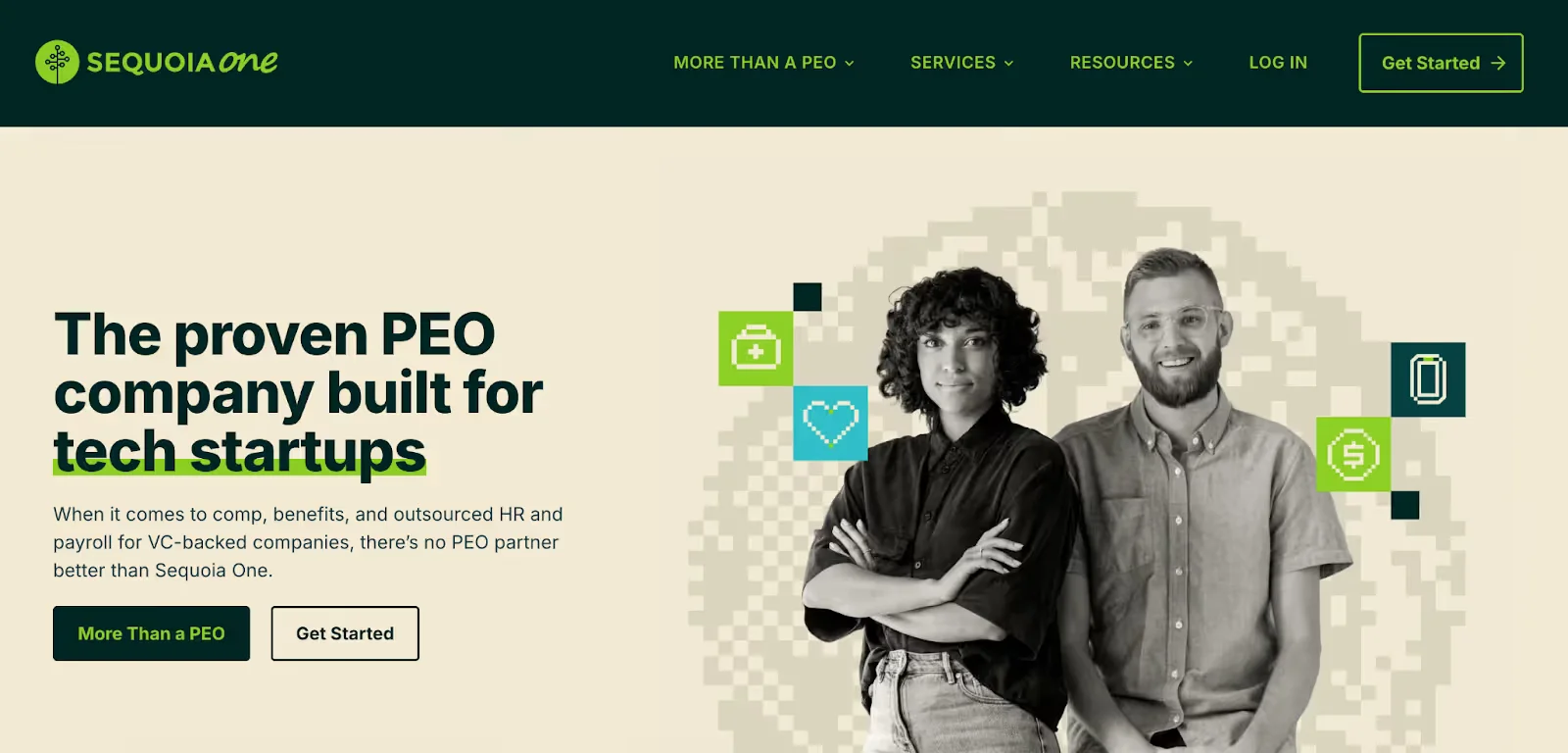
Next on our list of the best PEOs for startups is Sequoia One. It combines HR, payroll, benefits, and compliance support into a single offering.
Key Features
- Access to curated benefits plans: Sequoia One provides startups with a range of health insurance plans designed for growing teams.
- Dedicated HR advisory support: Teams get access to HR experts who can help with compliance, policies, and people operations.
- Compensation and benchmarking insights: Sequoia offers compensation data and guidance to help startups make more informed hiring and retention decisions.
Pricing
Contact for a custom quote.
Where Sequoia One Shines
- Strong people strategy support: It goes beyond basic HR admin by helping startups think through compensation, benefits, and overall people spend as a strategic lever.
- Backed by deep startup experience: With decades of experience working with tech startups, Sequoia brings a level of pattern recognition and guidance that general PEOs don’t offer.
Where Sequoia One Falls Short
- Less flexibility outside the PEO model: Benefits, payroll, and HR are bundled together, making it harder to customize or optimize each area independently.
- More than what smaller teams need: Early-stage startups may not need the level of structure, advisory, and services included.
Who Sequoia One Is Best For
- Venture-backed startups: Companies that want a more structured approach to compensation, benefits, and people strategy as they scale.
3. Justworks
.webp)
Justworks is a PEO that combines payroll, benefits, compliance, and HR support to help companies manage core people operations.
Key Features
- Simple payroll and benefits management: Justworks makes it easy to run payroll, manage benefits, and handle basic HR tasks.
- Compliance and HR support: It helps companies stay compliant with employment laws, taxes, and regulations. There’s also access to HR support when needed.
Compare Gusto vs Justworks for HR support.
Pricing
Where Justworks Shines
- Ease of use: Justworks keeps things simple, from running payroll to managing benefits. Teams can handle day-to-day operations without dedicated HR staff.
- International hiring support: The platform also supports global hiring, which gives small teams a way to hire and pay workers outside the US.
Where Justworks Falls Short
- Limited flexibility for more complex setups: As companies grow or need more customization, the platform’s simplicity can start to feel restrictive.
- Less control over benefits optimization: With benefits embedded inside the PEO structure, founders have limited ability to shop the market, benchmark renewals, or adjust their setup based on their team’s specific risk profile. That can lead to rising costs without clear visibility into what’s driving them.
If you’re looking for more control over your benefits spend, you may want to explore Justworks alternatives that offer greater transparency.
Who Justworks Is Best For
- Founders who want hands-off HR: Teams that prefer to outsource HR operations and rely on external support instead of building in-house processes.
4. TriNet

TriNet is a PEO that provides HR, payroll, benefits, and compliance support through a co-employment model. It combines a full-service HR setup with industry-specific expertise, so small and mid-sized companies can manage people operations with less internal overhead.
Key Features
- Industry-tailored support: TriNet adapts its HR services to different industries, which can be useful for companies that need more specialized support as they grow.
- Access to large-group benefits: Companies can offer employees benefits typically available to larger organizations, including medical, dental, vision, and retirement plans.
Pricing
Contact sales for a custom quote.
Where TriNet Shines
- Depth of experience: With 30+ years in the PEO space and 330,000+ worksite employees, TriNet brings a level of operational maturity that newer providers don’t.
- Handles complexity well: As headcount grows or operations span multiple states, TriNet takes on more of the administrative and compliance burden, reducing internal HR strain.
Where TriNet Falls Short
- Less flexibility in benefits setup: Like most PEOs, you’re limited to the plans and carriers within TriNet’s network.
- Renewal costs can become harder to justify as you scale: As headcount grows, companies can face higher renewal increases without much clarity into what’s driving them.
If you are experiencing this friction, evaluating top TriNet alternatives can help you find options with better price transparency.
Who TriNet Is Best For
- Growing SMBs with limited HR resources: Teams that want to outsource HR, payroll, and compliance as they scale.
- Companies operating in regulated or complex environments: Businesses that benefit from structured compliance support and guidance.
5. Deel PEO

Deel PEO is part of Deel’s global workforce platform. It helps companies hire, pay, and manage employees across the US and other countries.
Key Features
- Full-service payroll and tax handling: Deel manages payroll processing and handles federal, state, and local tax filings.
- Built-in compliance support: Dedicated HR experts help manage policies, filings, and regulatory requirements across states.
Where Deel Shines
- Global + US coverage in one platform: Useful for companies managing both domestic employees and international teams.
- Flexible setup compared to traditional PEOs: Companies can keep their existing benefits or move to Deel’s plans over time.
Where Deel Falls Short
- Less focused on benefits cost visibility: For companies focused specifically on reducing US benefits spend, Deel offers less visibility into what is driving renewal increases or whether their current setup is truly cost-efficient.
Who Deel Is Best For
- Companies hiring across borders: Teams managing US and international employees in one system.
You can also read our full Deel review to see a detailed breakdown of its features and setup options.
6. Gusto
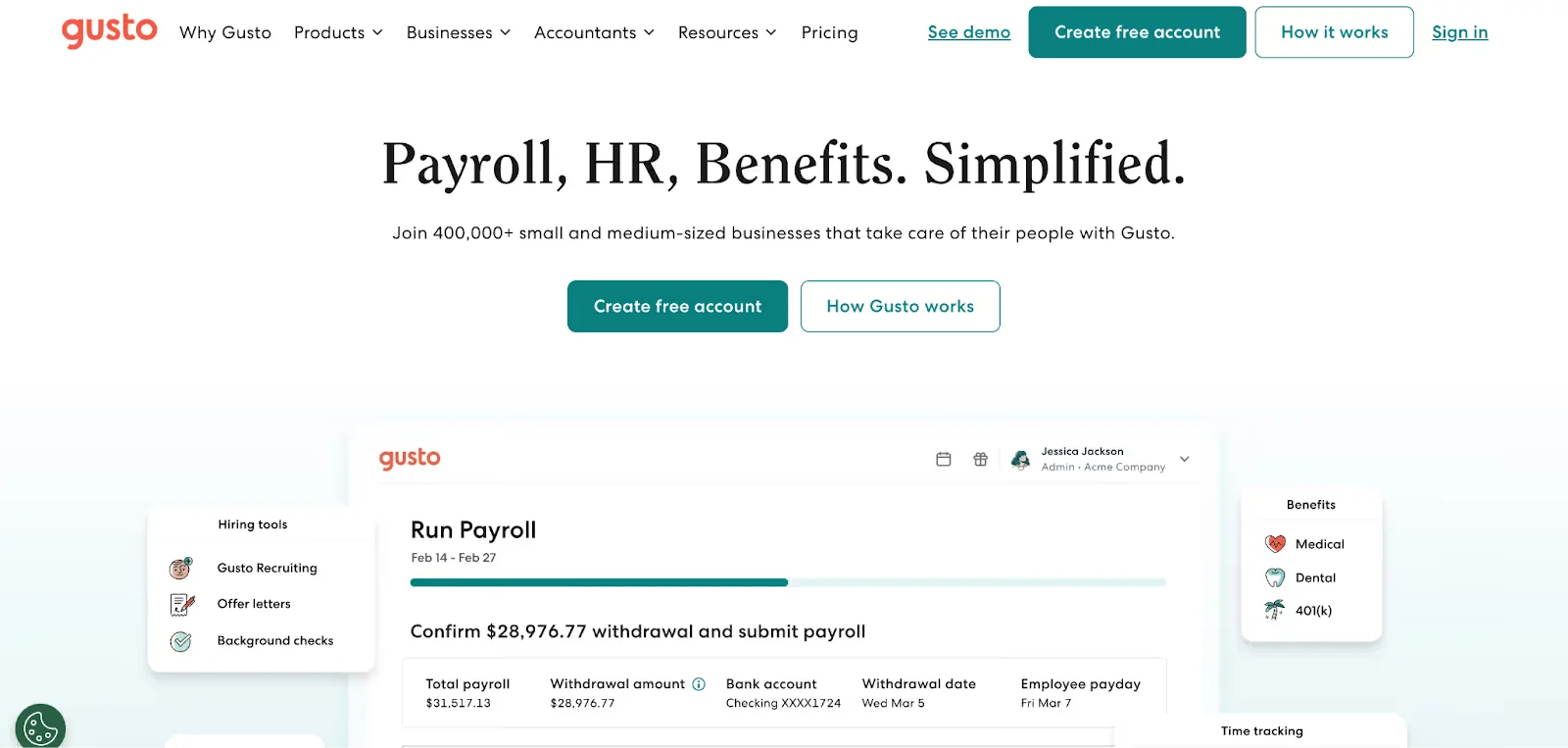
Next up is Gusto, an all-in-one payroll, HR, and benefits platform built for small and medium-sized businesses.
Key Features
- Automated payroll and tax filing: Run payroll in a few clicks while Gusto calculates wages, files taxes, and keeps everything compliant.
- Benefits management: Offer and manage health insurance, retirement plans, and financial benefits with built-in admin and advisor support.
Where Gusto Shines
- Simple, intuitive experience: Designed for non-HR users, making payroll and HR tasks quick and easy to manage.
Where Gusto Falls Short
- Limited visibility into cost drivers: Gusto simplifies plan selection and administration, but it doesn’t give founders much insight into why costs are rising or whether a renewal increase is competitive. If your goal is to actively reduce benefits spend, that lack of transparency can be a constraint.
You can explore our list of Gusto alternatives to see which platforms offer better visibility into cost drivers. Who Gusto Is Best For
Who Gusto Is Best For
- Small businesses and startups: Teams looking for a straightforward way to run payroll, manage HR, and offer benefits without heavy overhead.
7. Engage PEO

Engage is a full-service employer organization that helps small and mid-sized businesses manage HR, payroll, benefits, and compliance.
Key Features
- Payroll and tax administration: Engage offers payroll processing, time-and-attendance tracking, and tax-filing support.
- Employee benefits access: The platform provides medical, dental, vision, voluntary benefits, and a 401(k) program through national carrier partnerships
Where Engage PEO Shines
- Hands-on service model: Engage is built around outsourced HR support, which is why it appeals to businesses that want more guidance and less day-to-day admin.
Where Engage PEO Falls Short
- Less visibility into benefits cost drivers: Engage focuses on administering benefits, not exposing the underlying factors driving renewal increases or premium changes.
Who Engage PEO Is Best For
- Small and mid-sized businesses wanting hands-on HR support: Companies that prefer a traditional PEO with service-heavy support across payroll, benefits, and compliance.
8. Paychex
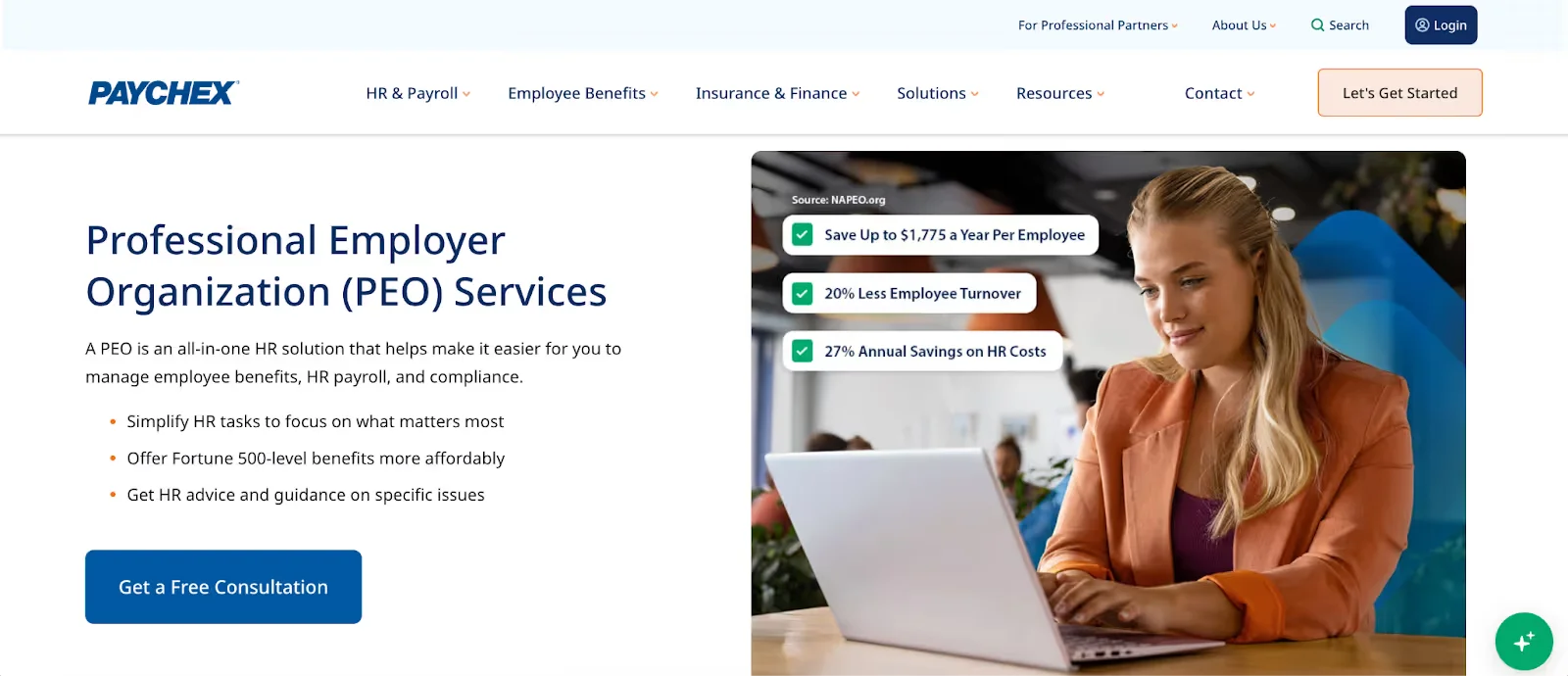
Paychex is a full-service payroll, HR, and PEO provider that combines software with dedicated support teams to help businesses manage employees, benefits, and compliance.
Key Features
- Dedicated HR support team: Access to a client advocate, HR business partner, and specialists for payroll and workplace safety.
- Benefits and insurance access: Offers health plans, retirement options, and business insurance through a centralized platform.
Where Paychex Shines
- Comprehensive risk and compliance coverage: Built-in support for workplace safety, workers’ comp, and multi-state compliance.
Where Paychex Falls Short
- Less streamlined than newer tools: The platform can feel more service-heavy and less intuitive compared to modern, software-first providers.
Who Paychex Is Best For
- Businesses that want hands-on support: Companies that prefer having a team of experts managing HR, payroll, and compliance alongside them.
What are the Signs Your Current PEO Setup Isn't Working?
PEOs can solve many early-stage problems. But as your team grows, the same setup can start to create new ones. Here are a few signs it may be time to rethink your approach.
1. Your Benefits Costs Keep Rising, but You Don’t Know Why
If you’re seeing double-digit renewal increases without clear reasoning or benchmarks, that’s a red flag. Most PEOs don’t show the underlying factors driving your pricing, so it’s hard to tell whether your rates reflect your team’s actual risk or whether you’re simply overpaying.
A good starting question: has your broker ever shown you the claims data and employee demographics your carrier is using to price your plan? If the answer is no, that’s your first sign.
Ignition Benefits brings that information into view, so you can better understand and challenge your costs.
2. You’re Locked Into a Bundled System You Can’t Break Apart
PEOs bundle payroll, HR, compliance, and benefits into one system, which means you can’t always adjust or optimize your benefits without affecting the rest of your setup.
Ignition separates benefits from the broader stack, so you can fix one of your biggest cost drivers without overhauling everything else.
3. You Have No Way to Benchmark or Negotiate Your Renewal
When your renewal comes in, you should be able to ask:
- Is this increase reasonable?
- Could we get a better rate elsewhere?
Most PEOs don’t give you the tools or data to answer those questions. You’re left accepting the quote as-is.
Ignition uses your actual risk profile to shop the market and negotiate on your behalf, so you’re not taking renewal pricing at face value.
4. You’ve Outgrown Your PEO, but Don’t Know How to Leave
Transitioning out of a PEO can feel risky, especially when benefits are involved. That’s why many startups stay longer than they should.
Ignition helps startups move off PEOs without disrupting coverage, making that transition much more manageable.
Get Your Benefits Risk Score Today With Ignition Benefits
Most of the tools in this guide can help you manage payroll, HR, or benefits.
But if you want to know whether you’re overpaying for coverage, or whether your current PEO still makes financial sense, you need Ignition Benefits.
We help founders and operators dealing with rising premiums, confusing renewals, or a PEO that no longer fits uncover what’s driving their benefits costs and what to do next.
Contact us to get your Benefits Risk Score and see if your current setup is costing you more than it should.



_%20Which%20One%20Wins%20for%20Your%20Team_.webp)

![How to Reduce Small Business Health Insurance Costs [2026]](https://cdn.prod.website-files.com/69f22330e53a32bb7629af15/6aa04b2f5dbdf3dc6b28b351_How%20to%20Reduce%20Small%20Business%20Health%20Insurance%20Costs%20%5B2026%5D%20(1).webp)
.webp)







.webp)

.webp)









.webp)





.webp)








.webp)




.png)

