.svg)

.svg)


.webp)

- Rippling is best for companies that want HR, IT, payroll, and benefits in one system, with the option to turn its PEO on or off.
- TriNet is best for small and mid-size businesses that want full HR outsourcing through a PEO, especially teams that want big-company benefits and hands-on HR expertise.
- Both Rippling and TriNet bundle your health benefits into a larger HR or PEO relationship. That bundling is convenient, but it hides what you actually pay for coverage and the risk score carriers use to set your premium.
- If your biggest concern is overpaying on health insurance, consider an independent broker like Ignition Benefits. It shares your workforce risk score upfront and shops every carrier at renewal, so a healthy team's benefits spend reflects its own risk instead of a pool average.
You might be looking at Rippling and TriNet for payroll, health benefits, compliance help, or all of it at once. The two companies handle those jobs in different ways, so the right choice depends on which function you want to outsource.
Here is the short answer. Rippling sells HR and payroll software you run yourself, with a Professional Employer Organization (PEO) you can turn on or off. TriNet is a PEO first. It runs payroll, sponsors your benefits, and handles HR compliance under a co-employment arrangement.
Both companies also sell your health insurance as part of a larger package. That can make it harder to see how much you’re paying for health insurance alone, even though it’s typically one of the largest costs in the package.
This guide compares the two on price, ease of use, support, and integrations. It also looks at how health insurance costs work with each option and when a separate broker could save you more.
Who Is Rippling Best For?
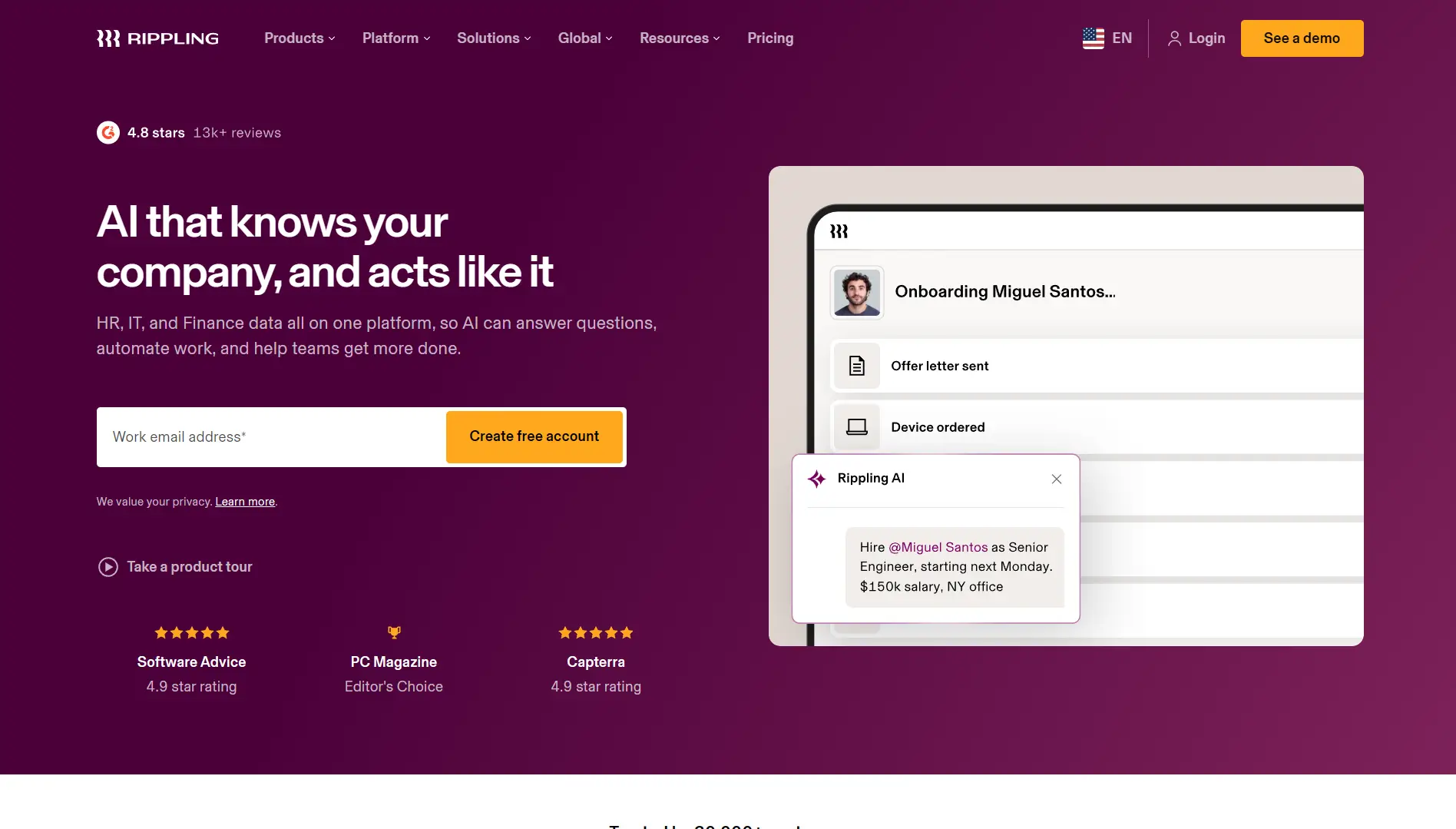
Rippling is a platform that connects HR, IT, and finance, with each product sold separately alongside a required core platform. You can run payroll, manage devices, administer benefits, and turn on a PEO when you want one. Rippling PEO is one of the largest in the United States, and you can opt out of it as your team grows.
Here's who gets the most from it:
- Companies that want HR and IT in one place: If onboarding a new hire means provisioning a laptop and email alongside payroll, Rippling handles both.
- Fast-growing teams that need flexibility: You add modules as you need them instead of buying a fixed bundle.
- Businesses that want a flexible PEO: Rippling lets you use its PEO, then move off it without rebuilding your whole HR setup.
- Teams with diverse tech stacks: Rippling has 650+ integrations.
Who Is TriNet Best For?
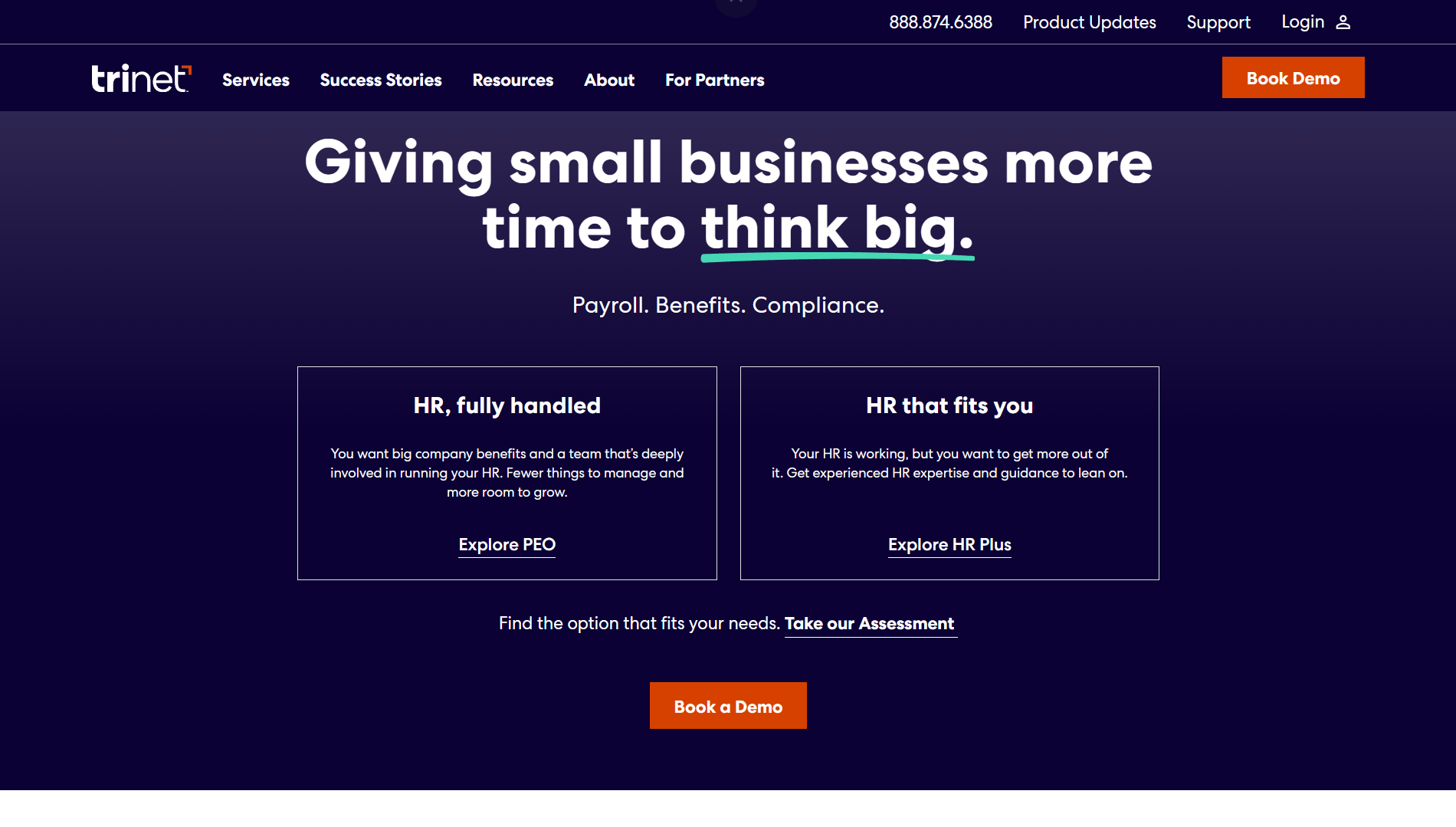
TriNet is a PEO that enters into a co-employment relationship with your business. It processes payroll under its tax ID, sponsors benefits, and handles HR compliance while business owners retain control over daily operations. TriNet serves companies ranging from five to more than 1,000 employees as stated on its website.
TriNet is a strong fit for:
- Teams without a dedicated HR person: TriNet's HR experts handle the work a founder would otherwise do.
- Companies that want big-company benefits: Small teams get access to medical, dental, vision, and a managed 401(k) they couldn't secure alone.
- Businesses in complex or multi-state situations: TriNet manages compliance across states and supports global workers in 150+ countries.
- Owners who want to offload risk: TriNet handles workers' compensation, which covers employees injured because of their work, and employment-practices liability, which covers claims such as discrimination, harassment, or wrongful termination.
▶ Watch the full TriNet review
Ignition Benefits: An Alternative
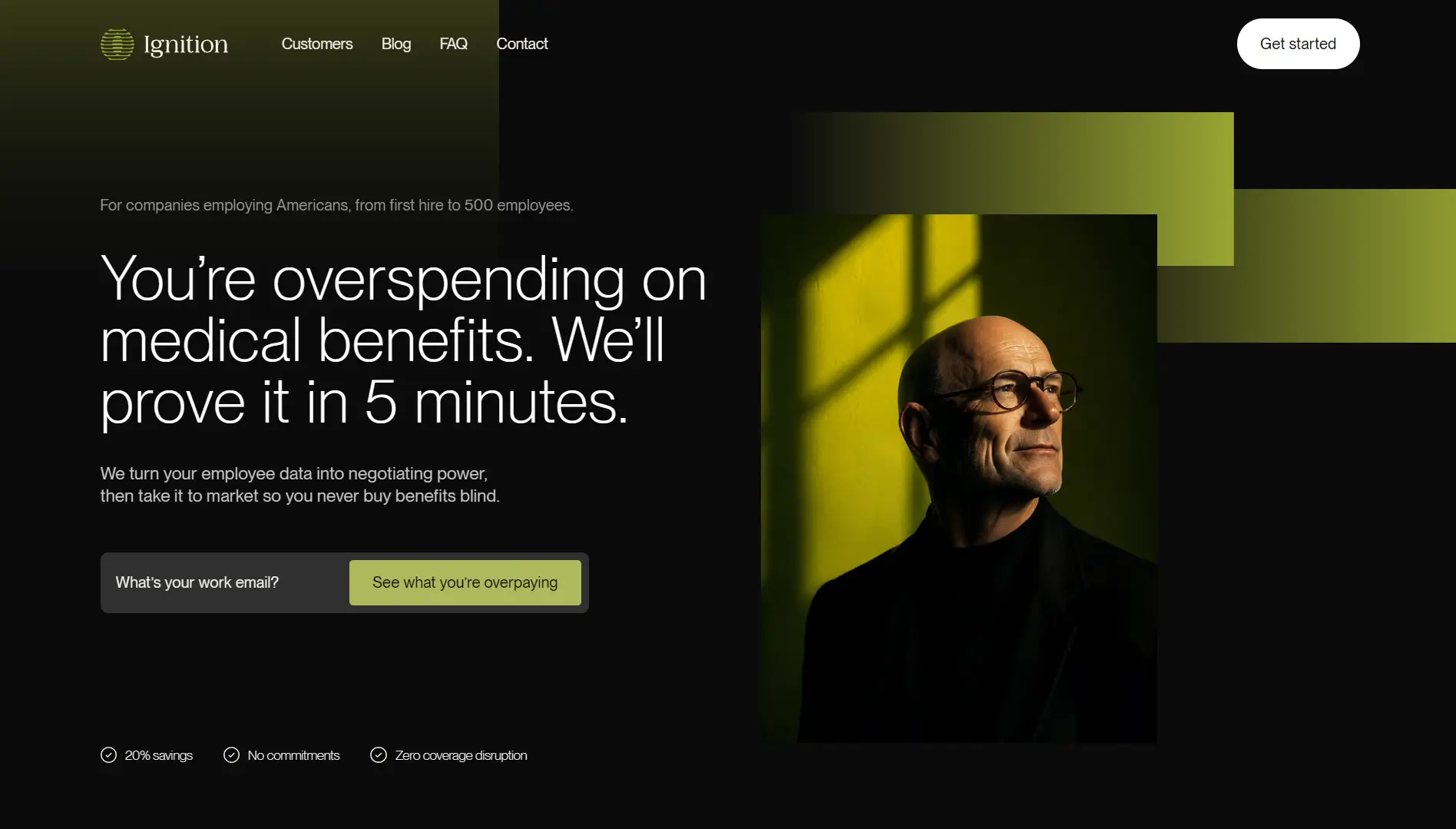
There's a reason to look past both platforms before you commit. Rippling and TriNet each treat your health benefits as one line inside a larger bundle. That works until benefits become your biggest cost, which happens fast. On most PEOs, health insurance runs 3 to 5 times the administrative fee.
Ignition Benefits is an independent benefits brokerage built for companies from their first hire up to 200 employees. It works alongside your payroll and HR system, concentrating on one job: getting you the right health coverage at a price that reflects your team's actual risk.
- Benefits Risk Score, shared upfront: Every carrier scores your workforce to set your premium. Ignition shows you that score before going to market, so you can push back when a renewal increase isn't justified.
- Full-market audit at every renewal: Ignition does not have a preferred pool but rather bids across every carrier, plan, and funding structure.
- Works with what you have: A single Broker of Record letter appoints Ignition. Your payroll and HR stay exactly as they are.
Find out if you're overpaying for employee benefits. Get your free benefits assessment
Price
Neither platform publishes its pricing, so both start with a conversation rather than a number you can look up. What differs is how the cost is built. One charges for each product you add to your bundle. The other charges a single flat fee per employee.
Rippling
Rippling uses modular pricing, so you pay for what you turn on.
- A required core platform: Every Rippling account starts with the core Rippling Platform, and each product is purchased separately alongside it.
- Modules priced separately: Payroll, benefits, IT, and other products each carry their own fee.
- Some products carry a base fee: Rippling notes that while most products are billed Per Employee Per Month (PEPM), some are charged at or include a monthly base fee.
- Quote-based: Rippling does not publish list pricing, so your total depends on the products you select.
TriNet
TriNet does not publish list pricing. You get a custom quote after a conversation about your company.
- Flat PEPM model: You pay a set fee per employee per month. For instance, if you have 20 employees at a $150 PEPM rate, your admin fee is $3,000 a month.
- Fees stay flat when pay rises: Unlike percentage-of-payroll models, your admin fee doesn't climb when an employee gets a raise.
- Benefits and taxes billed separately: The PEPM fee covers administration. Health coverage, workers' compensation, and payroll taxes are separate.
Verdict
Neither platform publishes list pricing. Rippling's modular model means your cost follows the products you use. TriNet uses a single PEPM fee that remains unchanged when an employee gets a raise. Rippling gives you granular control over what you pay for, while TriNet gives you a simpler, more predictable line item.
Ease of Use
The daily experience matters because you and your team use these platforms constantly. With one, you manage the software yourself. With the other, a team helps manage the work for you.
Rippling
Rippling is built as a single system where employee data flows across HR, IT, and finance.
- One source of truth: A change like a promotion updates payroll, and benefits automatically.
- Self-service for employees: Staff view pay, request time off, and manage their own details.
- Automation: You can build custom workflows to handle repetitive tasks.
The depth is the point, and it's also the learning curve, since more modules mean more to configure.
TriNet
TriNet pairs an all-in-one platform with expert support, so the software is only half the experience.
- One login for the employee lifecycle: Onboarding, payroll, and offboarding in one place.
- AI-powered help: Employees get answers and complete common HR tasks without waiting on a person.
- Experts on call: When you need help with an HR issue, you can speak with an HR professional instead of searching through help articles.
Verdict
This one depends on what you want. Rippling wins if you like controlling a powerful system yourself. TriNet wins if you'd rather lean on experts for HR and compliance issues.
Customer Support
Support is easy to overlook until payroll breaks or a compliance question can't wait. How each company handles that moment differs.
Rippling
Rippling uses an integrated specialist support model. Because HR, IT, and finance all sit on one platform, your support contact can see how these areas connect instead of looking at just one part of your account.
Rippling also runs a network of certified service partners who help with implementation, ongoing payroll, benefits administration, and compliance for teams that want hands-on help beyond standard support.
The self-run model means most day-to-day questions get answered inside the product, with human support for the more difficult cases.
TriNet
Support is central to TriNet's offering instead of an add-on. As a PEO, TriNet gives you access to HR professionals for the situations founders dread, from employee relations to benefits and payroll compliance.
- HR expertise on demand: A team of professionals helps with recruiting, onboarding, and complex employment questions.
- Compliance guidance: TriNet helps you stay current with federal, state, and local requirements.
- Established track record: TriNet has held ESAC accreditation since 1995 and operates an IRS-certified PEO subsidiary.
Verdict
TriNet wins on support depth for teams that want experts in their corner. That's the core of what a PEO sells. Rippling's support is strong and transparent, but it's built for people who mostly want to run the system themselves and call for help on the hard problems. If your team has no HR function, TriNet's model carries more of the load for you.
Integrations
Your HR platform has to fit the software you already run, or it creates more manual work than it removes.
Rippling
Rippling offers 650+ integrations across HR, IT, and finance. Because integrations connect to Rippling's unified data, an update to an employee's record can flow automatically into the connected apps.
Rippling is also compliant with Service Organization Control 2 (SOC 2) Type II, the General Data Protection Regulation (GDPR), and the California Consumer Privacy Act (CCPA), which matters when you're syncing employee data across systems.
TriNet
TriNet integrates with common business tools, including accounting systems like QuickBooks Online, so payroll can sync to your general ledger. TriNet also runs a marketplace of partner integrations. The connection count is narrower than Rippling's, which fits its model. TriNet handles more of the work as a service, so you rely less on setting up your own stack.
Verdict
Rippling wins on volume by a wide margin. If your business runs on many tools that need to talk to each other, Rippling is the better fit. If you're outsourcing HR to TriNet, you'll need fewer integrations by design.
Benefits Transparency
A standard feature list won’t tell you this, yet it can have the biggest impact on your costs. How much visibility do you get into what you pay for health insurance? And what’s the risk data behind that price?
Rippling
If you use Rippling's PEO for benefits, your team joins a pooled arrangement, and your premium reflects that pool. Rippling lets you bring your own broker instead of using its PEO benefits, which is an advantage if you want independent benefits advice alongside Rippling's software.
TriNet
As a PEO, TriNet sponsors your benefits and pools your team with its other clients to access group rates. That's how small teams get big-company plans. On the flip side, your premium is partly set by the claims history of every other company in the pool, not just your workforce. A young, healthy team can end up subsidizing higher-risk companies without knowing it.
Verdict
Neither platform is built to prove your benefits price is fair. Rippling gives you an exit by letting you use your own broker. TriNet keeps benefits inside the pool. If benefits transparency is your priority, that's the signal to bring in an independent broker for that one job.
How to Choose a PEO and HRIS Solution
Rippling and TriNet are both a PEO and an HR solution in one. That's the appeal, and it's also something to consider carefully. When one vendor runs your software, your payroll, and your benefits, convenience can quietly cost you on the line item that matters most. Here's what to check before you sign.
1. Can You See Your Benefits Cost on Its Own?
The clearest warning sign is that you can't separate what you pay for health coverage from the rest of the bundle. If a PEO won't break out your benefits cost or show the carrier risk score behind it, you have no way to check whether the price is fair.
This is where Ignition Benefits is built differently. It shares your Benefits Risk Score upfront, the same carrier score that sets your premium, so you can see whether your renewal price reflects your team's actual risk or the rest of a pool. Because the benefits cost isn't buried inside an HR or PEO bill, you can check the number against the market instead of trusting it blindly.
See where your benefits spend is justified. Get your free benefits assessment.
2. What Happens at Renewal?
Most bundled providers renew you into the same carrier pool at a higher rate, without shopping the market. Of the 503 business leaders Ignition Benefits surveyed in 2026, only a third got a proper explanation for their new premium, and 16% simply got a new number and a deadline. The fix is a real audit.
Ignition runs a full-market audit at every renewal, bidding across carriers, plan designs, and funding structures, and it delivers a report in 14 to 21 days rather than the 8 to 12 weeks a traditional broker takes.
3. How Hard Is It to Leave?
Bundling your benefits with your HR software or PEO creates lock-in. Leaving can mean rebuilding HR from scratch, and that inertia keeps companies paying longer than they should.
Ignition avoids this. It pairs with any payroll or HR platform, so improving your benefits doesn't mean leaving your existing systems. A single Broker of Record letter does the work, and everything else remains the same.
Alternative to Rippling and TriNet: Ignition Benefits
Rippling and TriNet both handle the administrative side of employment well. What neither is built to do is fight for a better deal on one of your largest costs, health insurance. Ignition Benefits was built to solve exactly that. It's an independent brokerage that uses your team's actual data to audit the full market at every renewal, aiming for the same or better coverage at a lower price.
Ignition was founded by Nick Taranto, who scaled Plated to 1,500 employees before its acquisition by Albertsons. He built the brokerage after years of watching brokers collect commissions at every renewal without shopping the market for him.
Key features
Three things separate how Ignition works from a bundled PEO or HR platform.
Benefits Risk Score
Every carrier already assigns your workforce a risk score based on age, gender, and location, and that score drives your premium. Most founders never see it. Ignition shares it with you before going to market. If your team is young and healthy and that score is low, it's evidence that a renewal increase may not be justified, and Ignition uses that gap to negotiate.
Full-Market Audit
At every renewal, Ignition runs a competitive bid across every available carrier and plan, not a preferred pool. The audit includes a funding structure review: whether you should stay fully insured, move to level-funded, or consider self-insurance.
Benefits Analysis Report
Ignition delivers a full Benefits Analysis Report in 14 to 21 days, compared to the 8 to 12 weeks a traditional broker takes. It shows what you pay today, what alternatives exist, and the clear recommendation, written in plain language for a founder.
Ignition Benefits Pricing
Where Ignition Benefits Shines
- Savings tied to your real data: Because it prices against your team's actual risk instead of a pool average, low-risk workforces often see the biggest reductions. Most clients save around 20% in year one.
- No disruption: It works alongside your existing payroll and HR, so nothing in your stack has to change.
Where Ignition Benefits Falls Short
- It's not an HR or payroll system: Ignition handles benefits, not payroll processing, device management, or full HR administration. If you need those, you still need a platform like Rippling or a PEO like TriNet.
- It's focused on US employees: Ignition is built for companies with up to 200 US-based employees.
Customer Reviews
“We assumed Gusto was getting us a fair deal on benefits. Two short calls with Ignition saved us six figures and got us better coverage than we'd ever had.” Robert McConchie, Chief Financial Officer & Co-Founder, AWM Capital.
“I didn't realize how much money we were leaving on the table until Ignition ran the numbers. We saved $113,000 in year one, on a 25-person team. For a company our size, that makes a big difference.” Nick Mares, CEO, Light Labs.
Who Ignition Benefits Is Best For
- Founders with a young, healthy team of up to 200 employees: If your workforce is low-risk, you're the likeliest to be overpaying inside a pool and the likeliest to save.
- Companies that outgrew their PEO: Teams that want to keep their software but stop overpaying on benefits.
- Founders and operators who want proof: Anyone who wants to see the risk score and the full market before making a call.
See what you're overpaying. Get your free benefits assessment
What Will You Choose?
Here's how to decide. Choose Rippling if you want a flexible platform to run HR, IT, and payroll yourself, with a PEO you can switch on or off. Choose TriNet if you want to hand HR to experts and get big-company benefits through an established PEO.
But if the real question keeping you up is whether you're overpaying on health insurance, neither bundle answers it. Ignition Benefits does. It works alongside whichever HR system you choose.
FAQs
Can I Use Rippling and TriNet Together?
Rarely. Both are full HR or PEO systems that overlap heavily, so running both duplicates cost and effort. Most companies pick one.
What Happens to My Existing Health Plan if I Switch to TriNet?
It usually changes. As a PEO, TriNet sponsors benefits through its own pooled plans, so you typically move onto TriNet's offerings rather than keeping your current plan.
Are Rippling and TriNet Available in All 50 States?
Yes. Both operate nationwide and handle multi-state payroll and compliance across all 50 states.
How Long Do Rippling and TriNet Contracts Run?
It varies. PEO agreements commonly run 12 months. Rippling's terms depend on the modules and plan you choose, so confirm the length in your quote.
Is Rippling Actually a PEO?
Yes and no. Rippling offers a PEO, and it's one of the largest in the US, but it's optional. You can run Rippling's HR software without the PEO and turn it on only if you want co-employment.



.webp)



.webp)

.webp)









.webp)





.webp)








.webp)




.png)