.svg)

.svg)


.webp)

- Deel is a strong fit for companies hiring across borders that want one platform to run global payroll, contractor management, and employer-of-record hiring.
- Founders who adopt Deel's US PEO often find the platform excellent at logistics but quiet on how their benefits renewal price actually gets set.
- Ignition Benefits is the better alternative if your team is US-based and you care less about global reach than about knowing whether you're overpaying for coverage.
- Deel administers your benefits as part of a bundled platform, while Ignition Benefits independently shops them, with visibility into Benefits Risk Score, a full-market audit, and broker pay disclosed on day one.
You're likely evaluating Deel because you're hiring in more than one country, or your team is spreading out and the patchwork of contractors, payroll tools, and local rules has become its own job. These are problems Deel was built specifically to solve.
Deel is one of the most capable workforce platforms available, and for global hiring it's one of the best out there. But the excellent hiring features don’t tell you much about whether its benefits model is the right one for a US team watching its costs.
If you want to know whether Deel's platform earns its place in your stack, this review breaks down its features, pricing, strengths, weaknesses, and real customer feedback. It also shows which companies get the most from Deel, and which are better served elsewhere.
Who Is Deel PEO Best For?
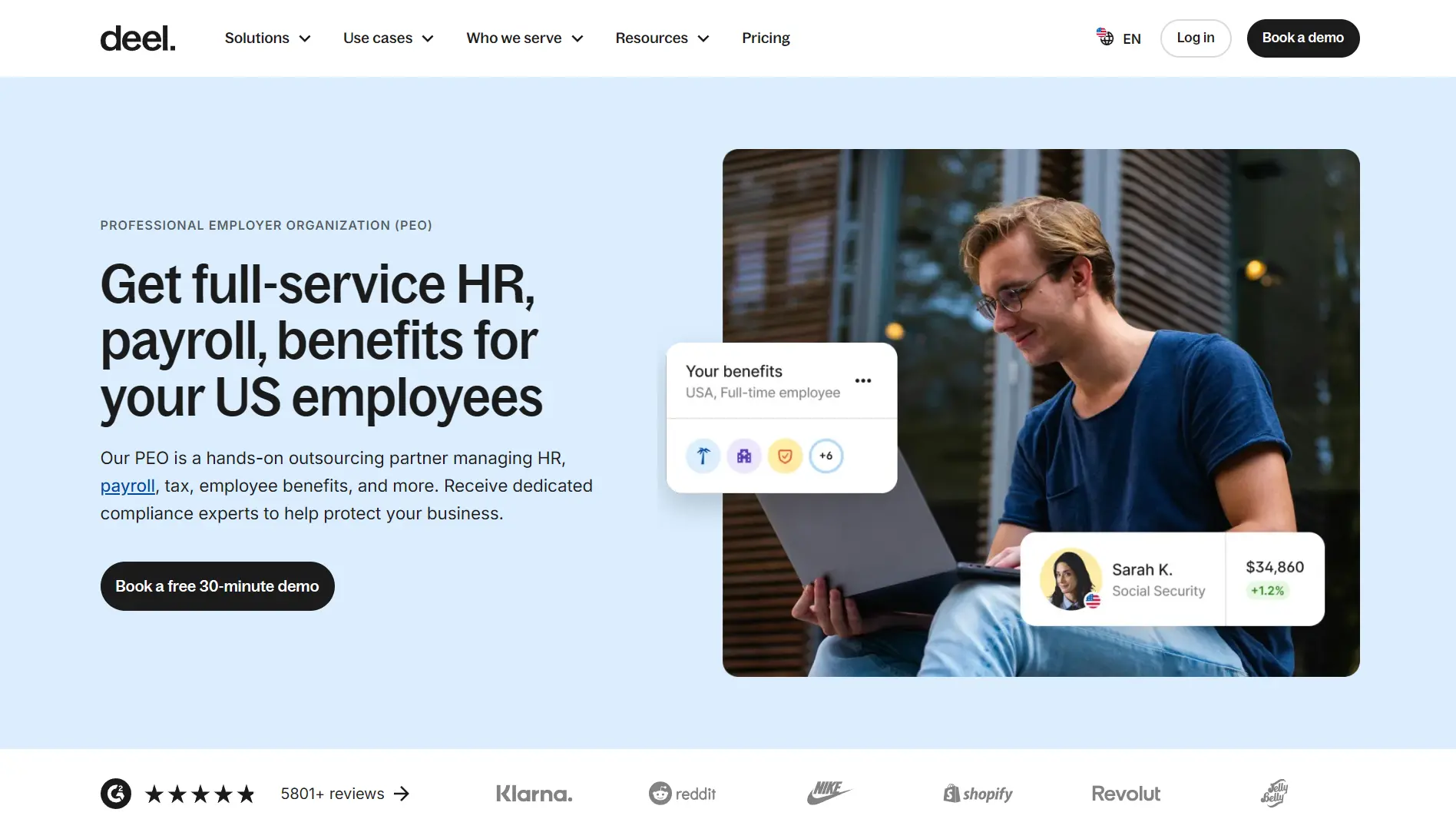
Deel's PEO is a US-only product built on a co-employment model, so it fits companies that already have a US entity and want to hand off the administrative side of employing people. Unlike most PEOs, Deel lets you keep your existing benefits broker and plans, or move into its own plans later. It's a strong fit if:
- You have a US entity and want payroll, tax, HR, and compliance run for you under one co-employment agreement
- You're operating across multiple US states and need someone tracking state-by-state filings, unemployment insurance, and local rules
- You don't have a full HR function and want a dedicated HR Business Partner for compliance questions like EEOC, FMLA, OSHA, and COBRA
- You want access to Fortune 500-level benefits from carriers like Aetna and Kaiser Permanente that a small business can't reach on its own
- You already use Deel for international hiring and want your US employees managed on the same platform
Deel PEO Key Features
Deel's PEO is a US co-employment service, which means you keep your entity and your day-to-day management, while Deel takes over payroll, tax, compliance, and benefits administration. The features below show what the PEO actually does for you, and where it has limits.
1. Onboarding
Onboarding rules change from one state to the next, and that’s where small teams get confused. Deel localizes every step for you, from minimum wage to the state-specific documents a new hire has to sign, so you stay compliant without knowing the rules yourself.
Deel says a new employee can be fully set up in about five minutes, with the paperwork, tax forms, and enrollment handled in one sequence. For founders doing this by hand, this feature saves the time otherwise spent cross-checking state requirements.
2. Payroll and Tax
Deel runs payroll across all 50 states and files taxes at the federal, state, and local level, so deposit schedules and reciprocity rules aren't your problem. As co-employer, Deel becomes the employer of record for payroll and tax, moving that filing liability off you.
Billing is per employee, with no separate charges for platform, payroll, or benefits admin. This flat structure is cleaner than the percentage-of-payroll model some PEOs use, where your cost climbs every time you give a raise.
3. Benefits Enrollment
Deel PEO opens up Fortune 500-level plans a small business can’t reach alone, including national medical, dental, vision, life, 401(k), and supplemental options like HSA/FSA and fertility coverage. Employees enroll and manage it all on the platform. To help staff choose the right options during enrollment, platforms often integrate benefits decision support tools to walk employees through their coverage options.
Deel is unusually flexible here, letting you keep your existing broker and plans, or move into Deel's plans whenever you're ready.
The limit is the same one every pooled PEO shares. Once you're on Deel's plans, your renewal price comes out of the pool, and the risk data carriers used to set it never reaches you.
4. Time Tracking
Time tracking lives in the same system as payroll, so logged hours flow straight into each pay run without anyone re-keying them. For teams with hourly or non-exempt staff, that link removes a common source of payroll errors.
Tying hours, pay, and compliance together is useful for a lean team, though it's a supporting feature rather than a reason on its own to choose Deel.
5. Reporting
Because onboarding, payroll, benefits, and time all sit in one place, the PEO gives you a single view of your workforce instead of numbers scattered across separate tools. You can see headcount, labor cost, and benefits spend without assembling them by hand.
This consolidated reporting is a clear win for teams with no internal HR team. However, the reports don’t tell you whether your benefits cost is fair. They only show a number, but not how your workforce was rated to produce it.
For a complete breakdown of its platform features, pricing, and services, you can read our comprehensive Deel review. The features below show what the PEO actually does for you, and where it has limits.
Deel PEO Pricing
Deel’s US PEO starts at $125 per employee per month, billed per employee rather than as a percentage of payroll, and it requires a US legal entity since co-employment runs alongside your own company.
For a complete breakdown of contractor, EOR, and platform costs, you can review our full guide on Deel pricing.
A PEO folds its margin into one bundled per-employee rate you can't break apart. Ignition is paid the way every broker is, through carrier commissions, but tells you the exact amount upfront. See exactly what you're paying for.
Deel Positives
- Full-service HR in one place: Payroll, tax, compliance, benefits, and onboarding run under one co-employment agreement, so teams without dedicated HR can hand off the administrative load.
- Dedicated HR Business Partner: You get a named compliance expert for EEOC, FMLA, OSHA, and COBRA questions, not a 1-800 hotline.
- Strong compliance and security: SOC 2, ISO 27001, and GDPR with annual audits, plus in-house legal that keeps contracts current as laws change.
- Fast onboarding and clean UI: Reviewers across G2 and Capterra repeatedly cite ease of use and quick setup, even for first-time payroll buyers.
- Keep your existing broker and plans: Deel doesn't force you onto its benefits. You can stay with your current broker and plans, then move into Deel's later if you want.
Deel Negatives
- No visibility into benefits pricing: The pooled US structure hides your workforce's risk score, so renewals arrive without the data to evaluate them.
- Support degrades at scale: An AI bot fronts human help, and reviewers report slow responses during payroll and compliance crunches.
- US entity required: The PEO only works if you already have a US legal entity, so it's not an option for companies trying to hire here without one.
- Co-employment lock-in: Payroll, benefits, and compliance are bundled into one agreement, so leaving later means unwinding all of it at once rather than swapping a single piece.
You don't have to accept a renewal you can't see inside. Ignition pulls your workforce's risk score and runs your plan against a wide range of carriers, so you walk into the next renewal with the numbers, not a take-it-or-leave-it quote. Get your free benefits analysis
Deel PEO Customer Reviews
Deel rates highly for breadth and ease of use across G2 and Capterra. However, reviewers share a common complaint about their experience using the platform, citing performance issues and glitches. Pricing is also a concern, with many reviewers stating that the costs don’t scale well with headcount.
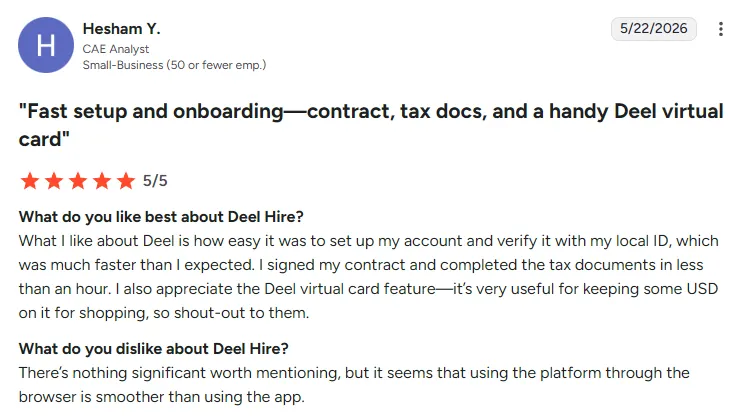
Hesham Y. (G2): This reviewer credits the ease of setup and onboarding, noting that it was much faster than they expected. They did state that running the app on the browser was smoother than the app.
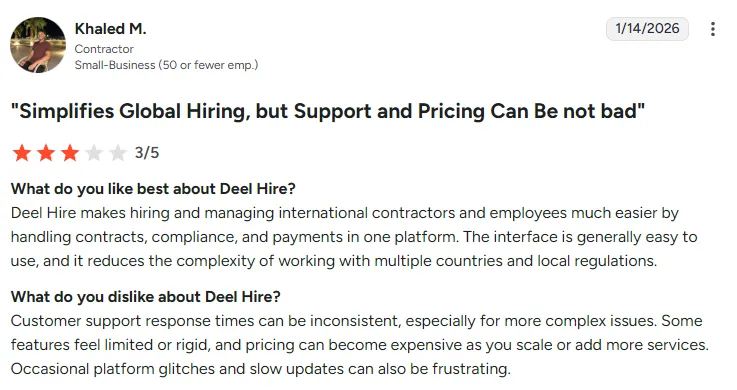
Khaled M. (G2): This reviewer states that Deel makes hiring and managing international contractors and employees much easier. However, they noted that the support response times are inconsistent, and that features become more expensive as you scale. The platform was also reported to have frustrating glitches and slow updates.
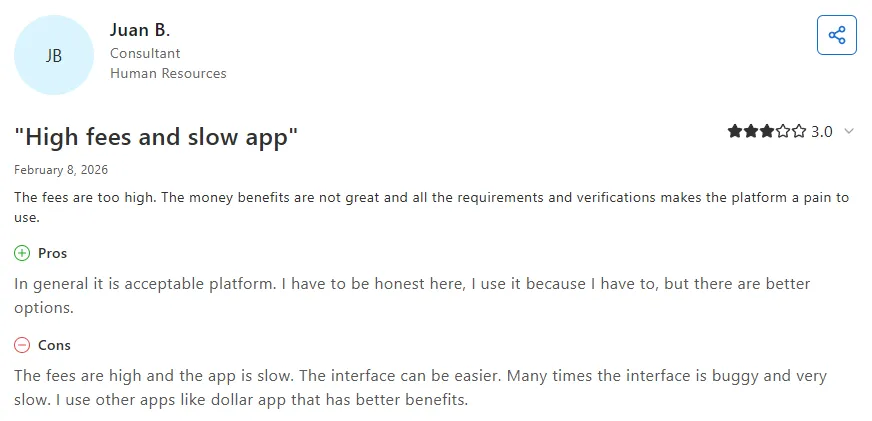
Juan B. (Capterra): Juan says that the platform is acceptable, but acknowledges that there are better options. They also complain about the high fees, and slow performance, particularly on mobile.
Deel Overall Verdict
Think of Deel as infrastructure first and a benefits provider second. Almost everything it does well, owned entities in 120+ countries, automated multi-country payroll, and automatic contract rewrites are designed to get people hired and paid wherever they live.
Where it starts to fall short is exactly where the US benefits decision begins. Once your team is on the pooled plan, you no longer have visibility into the exact pricing structure for your benefits. And when you need human support, the platform’s user experience is often discouraging.
Deel was engineered to solve the problem of hiring across borders, and it's worth paying for. But if you suspect that you're overpaying for US coverage, Deel isn't built to answer that question. Know which one you're actually trying to fix before you sign.
If you suspect you're overpaying for US coverage, a full-market audit compares your current plan against the wider market and shows your cost breakdown. Get your full-market audit to see whether your team is on the right plan before you renew.
Ignition Benefits: An Alternative to Deel PEO
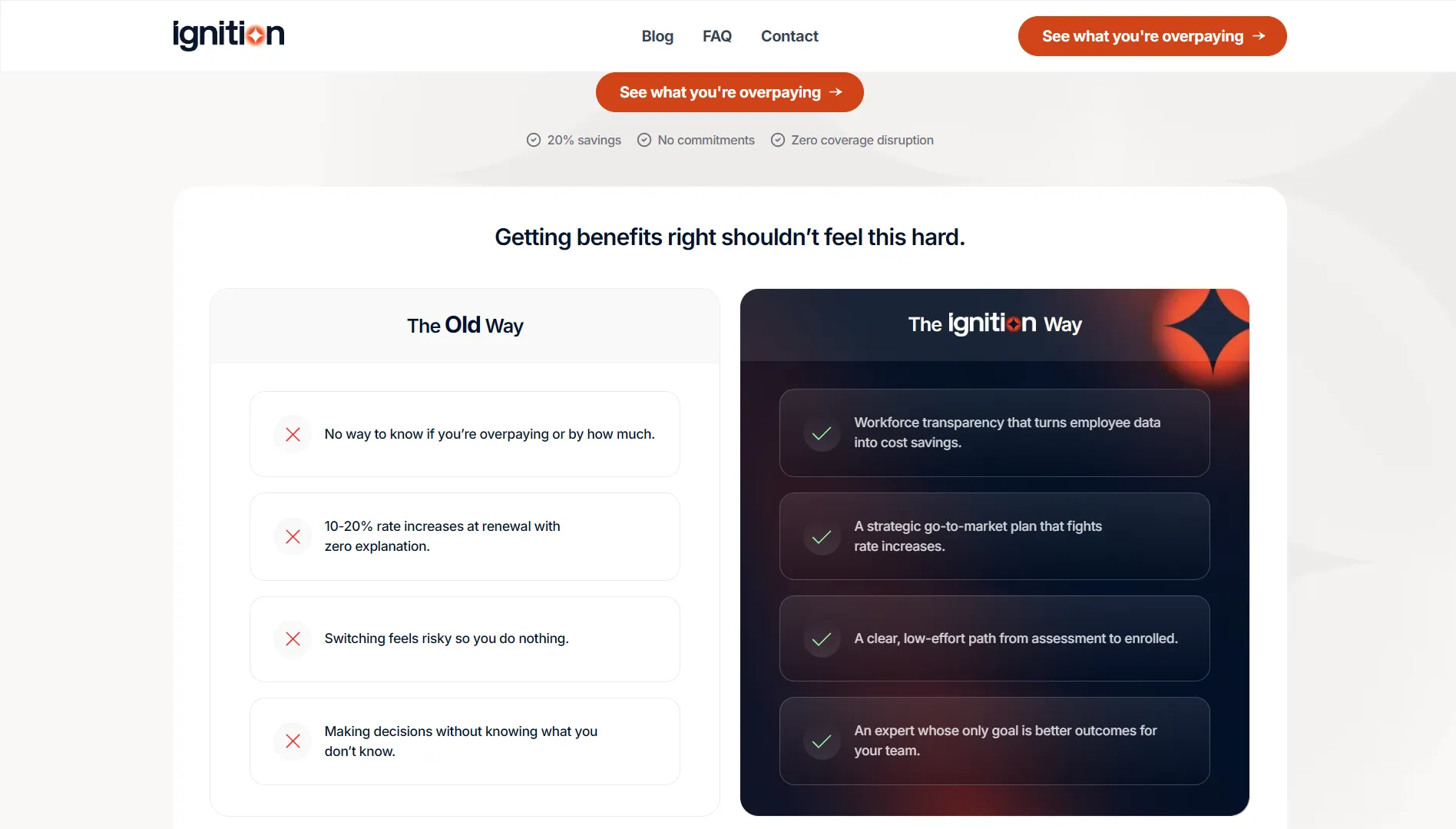
Deel is built around the logistics of hiring people anywhere. But it doesn’t tell you whether the benefits attached to those US hires are priced fairly for your specific team. Ignition Benefits fills that gap, focusing on showing you what your workforce should actually cost to insure.
Here's what Ignition Benefits does differently:
- Full fee transparency from day one: Every dollar of compensation is disclosed upfront, including commission, at zero cost to the employer.
- A full-market audit at every renewal: Every carrier, plan, and funding structure is evaluated against your workforce data, with no preferred network.
- Benefits Risk Score visibility: Ignition surfaces the actual risk score carriers already assign to your workforce, so you can see whether your low-risk team is quietly subsidizing a riskier pool.
- No platform lock-in for benefits: Keep Deel, or any payroll and HR setup, exactly as it is. A single Broker of Record letter moves the benefits relationship to Ignition with no other changes.
Deel vs Ignition Benefits comparison
Most companies on a PEO have never seen what the open market would charge for their workforce, because no one has checked. Ignition pulls your risk score and takes it to carriers as leverage, at no cost to you. See where you're overpaying.
How to Choose HR / Employee Benefits Software
The trap here is treating "global hiring" and "benefits cost" as one purchase. They're two problems that overlap in places, but most tools that work for one tend to fall short on the other. Answer these four questions to know your exact needs.
1. Global Reach vs. Benefits Depth
Are you mostly trying to hire people in places you have no entity, or mostly trying to stop overpaying benefits for the US team you already have? Deel's EOR and contractor products solve the first problem. The second needs a full market analysis, which a global platform doesn't produce. Ignition does, with a full audit and a report inside 14 to 21 days.
2. An Independent Market Audit
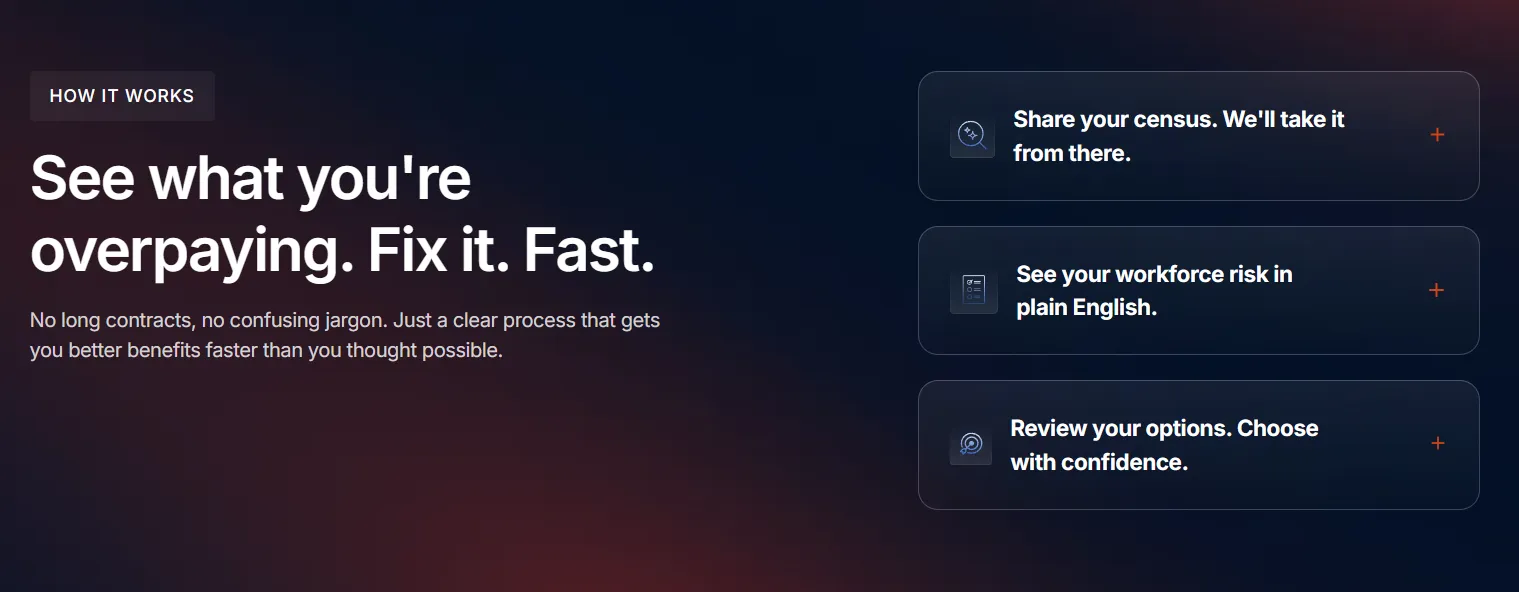
Push any provider on what "we shop the market" means in practice. A proper audit puts your census in front of every carrier and lines the quotes up side by side, every year. A pooled plan only ever shows you the inside of its own pool, which can cost a healthy team up to six figures more than it should be paying.
3. Funding Structure Options
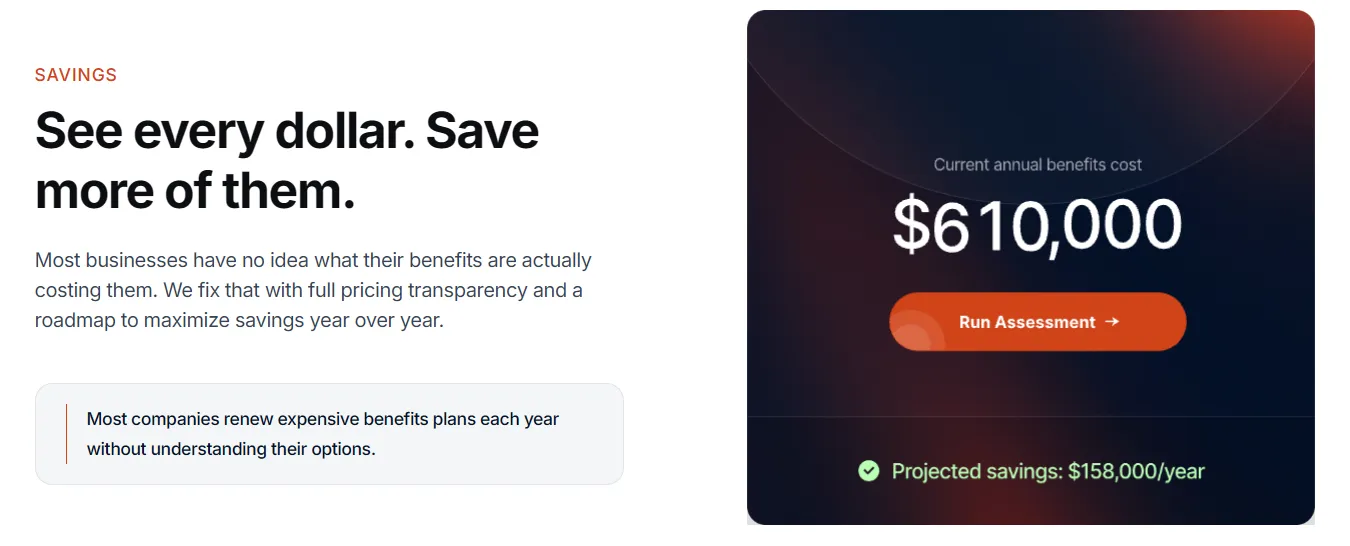
Fully-insured is the default almost everyone gets handed, and it means the carrier keeps whatever your team doesn't spend. Ask specifically about level-funded options, where low claims years can send money back to you at renewal.
4. How Easily You Can Move Benefits
Before you commit, ask how you’d leave. When benefits are wired into the same platform as your payroll, untangling them later is a big project. A standalone broker arrangement ends with a single Broker of Record letter, and your payroll remains where it is.
Alternative to Deel PEO: Ignition Benefits
Ignition Benefits is an AI-native brokerage for founders and teams of up to 200 employees designed so the employer sees the same pricing data the carriers do, instead of taking the renewal on faith.
Ignition Benefits Key Features
Where Deel wraps benefits inside a larger payroll-and-hiring platform, Ignition doubles down on figuring out what your specific workforce should cost to insure, and proving it. Three features make that work.
1. Benefits Risk Score Visibility
Before any carrier quotes you, it has already scored your workforce, using age, gender, location, and the actuarial math behind them. If you drop into a pooled plan, that score disappears into an average built from thousands of other companies.
Ignition retrieves it and puts it in front of you first. A low score next to a high premium shows the entire argument: you're being charged for risk you don't carry, and now you have the number to say so.
2. Full Market Audit
Every renewal, Ignition runs your census across the market, comparing options from a wide range of carriers and every funding structure, whether fully-insured, level-funded, captive, or self-insured. Most PEOs skip this part without telling you, settling for two or three quotes and ending the search.
Most brokers earn more when your premium is higher, so showing you a cheaper plan works against their own pay. Ignition's compensation is disclosed and fixed up front, so the recommendation follows your workforce data, not the commission.
A young, healthy team often pays pool prices that don't reflect its actual risk. A full-market audit shows the gap in plain numbers. Get your free benefits analysis
3. Benefits Analysis Report
The Benefits Analysis Report is Ignition's core deliverable. It is a plain-language comparison of every market option, a workforce risk profile, and a clear funding recommendation. The report is designed to be clear and understandable without expertise in benefits.
Most traditional brokers take 8–12 weeks to produce something comparable. Ignition delivers it in 14–21 days through AI-native tooling that compresses the process without reducing the analytical depth.
Ignition Benefits Pricing
Carriers pay brokers a commission, and that's true everywhere. What sets Ignition apart is that the figure is plainly revealed before you decide anything, with nothing added to your invoice.
Where Ignition Benefits Shines
- Transparency that's enforceable: You see every dollar of compensation on the first call, a right the CAA 2021 already gives you and almost no one acts on.
- A search that actually covers the market: Every carrier and funding type, weighed against your own data, rather than a token handful of quotes.
- A process founders can fit in: Two calls and a report, not a procurement cycle that drags across a quarter.
Where Ignition Benefits Falls Short
- US-only: The mandate stops at the US border, so anyone hiring abroad should keep a platform like Deel for those workers.
- Built for 10+ employee teams: Ignition works best once you have at least 10 employees, since the funding options and market leverage need that scale to pay off. Smaller teams have fewer levers to pull, so the savings case is weaker.
Ignition Benefits Customer Reviews
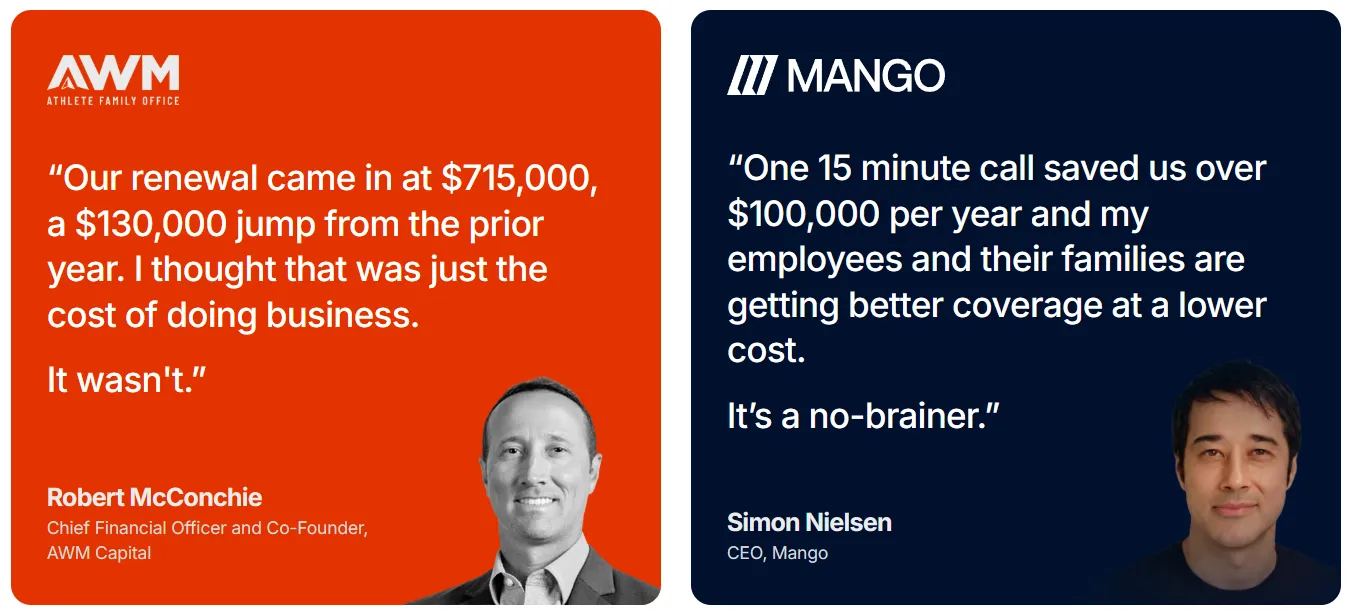
The pattern among Ignition’s clients is the recognition that an increase they'd accepted as the quirks of insurance carriers turned out to have been optional.
Simon Nielsen, who runs Mango, puts a number on it, saying a single 15-minute call took more than $100,000 a year off his costs while his employees and their families ended up with better coverage than before.
The Right HR/PEO Tool Depends on What You Actually Need
Match the tool to the problem in front of you. If the problem is hiring people in countries where you have no entity, paying contractors across borders, and pulling a scattered workforce into one system, Deel is built for precisely that and earns the cost.
If the problem is a US benefits renewal that keeps climbing on a plan nobody has ever put to the test, Deel can administer it but can't diagnose it. Ignition can, and it hands you the carrier's own Benefits Risk Score on your workforce and a full-market recommendation in 14 to 21 days, without a dime.
FAQs
Is Deel Legit?
Yes. With 40,000+ clients (as per Deel’s website) and strong scores on G2, Capterra, and Trustpilot, Deel is a well-funded, established platform.
Who Ignition Benefits Is Best For
The founder, CEO, CFO, or first HR hire at a US company with up to 200 employees who is on a PEO or fully insured plan they've never had independently audited, is running a younger, healthy team, and is triggered by an unexplained renewal increase or growing headcount.
Is Deel Good for Small Businesses?
Depends on the business. A small company hiring internationally gets a lot out of Deel. A small company hiring only in the US may find it's paying for reach and complexity it doesn’t need.
Does Deel Handle Employee Benefits?
Yes, via its US PEO, covering health, retirement, and the rest. The catch is that renewal pricing comes from the pool, not from your own workforce's risk profile.
What Is Deel's Biggest Weakness?
You can't see how carriers price your benefits, and the costs increase, while support stretches thin as you grow. Renewals show up without the underlying numbers to challenge them.
Can I Use Deel Just for Payroll?
Yes. Global and US payroll are sold on their own, separate from EOR and the PEO, so you can run payroll without taking on co-employment.



_%20Which%20One%20Wins%20for%20Your%20Team_.webp)

![How to Reduce Small Business Health Insurance Costs [2026]](https://cdn.prod.website-files.com/69f22330e53a32bb7629af15/6aa04b2f5dbdf3dc6b28b351_How%20to%20Reduce%20Small%20Business%20Health%20Insurance%20Costs%20%5B2026%5D%20(1).webp)
.webp)




.webp)



.webp)

.webp)








.webp)





.webp)








.webp)




.png)

