.svg)

.svg)


.webp)

- Choose a PEO if you're under 20 to 25 employees, have limited HR capacity, and want payroll, benefits, and compliance handled under one roof.
- Choose an ASO if you want HR administration support but need full control over benefits, carrier relationships, and employer responsibilities.
- The inflection point is around 50 employees. Most healthy startups on a PEO hit a wall around this threshold because they’re pooled with riskier employers and are subsidizing their claims.
- Neither model fixes opaque benefits pricing. Whether on a PEO or ASO, most founders have never seen a full-market benefits audit or their carrier's risk score. Ignition Benefits surfaces that score and uses it to negotiate a better rate at your renewal.
Your renewal jumped again, and nobody could explain why. Or your company is growing and you're wondering whether you'd be better served by an ASO than your current PEO. Either way, the question comes down to the same thing: what does a PEO actually do that an ASO doesn't, and which model fits where your business is now?
A PEO enters into a co-employment arrangement, sharing certain payroll, tax, and benefits responsibilities with you while you keep control over day-to-day management. An ASO provides the same administrative support without entering into co-employment, so the employment relationship stays entirely with you.
For founders operating in the 20 to 100 employee range, those tradeoffs become more important as headcount grows. This guide breaks down the key differences between ASO and PEO and the signs it may be time to rethink your current approach.
ASO vs. PEO: Quick Comparison Table
The table shows that the main tradeoff is that a PEO bundles more but prices you inside a pool that may not reflect your workforce's actual risk. An ASO gives you more control and flexibility, but compliance liability stays entirely with you.
ASO vs. PEO: Key Differences
Cost is often what starts the conversation, but employment responsibility, benefits control, and long-term flexibility usually determine which model makes sense. The five differences below have the biggest impact on how a company operates as it grows.
1. Employment Structure and Employer Responsibility
With a PEO, you enter a co-employment relationship. The PEO becomes the employer of record for payroll, taxes, and benefits, meaning your employees' W-2s carry the PEO's name and payroll taxes are filed under the PEO's EIN.
With an ASO, none of that happens; you remain the sole employer. The ASO is simply a vendor handling specific administrative tasks, but your employees are always legally and financially yours.
If you leave a PEO mid-year, FICA and FUTA taxes for each employee will be non-transferable, and the wage bases restart, resulting in double taxation. State unemployment insurance complications can follow, which are unbudgeted costs that often catch founders off guard.
Pro Tip: If you're evaluating a PEO, ask specifically how they handle EIN filing. Some founders discover at tax time, not before, that their employees' tax documents carry an unfamiliar entity name.
2. Benefits Access and Insurance Strategy
Benefits are where the practical differences between a PEO and an ASO are most visible. With a PEO, your health coverage is tied to the PEO's master group plan. You select from whatever options they make available, and your ability to customize plan design, switch carriers, or adjust contribution structures is limited to what the PEO offers.
An ASO provides no benefits of its own. You source coverage independently through a broker, which means you choose the carrier, the plan design, and the funding model. Working with an expert partner helps you realize the full benefits of consulting firms when evaluating these options. That can open up opportunities unavailable inside a PEO's pooled arrangement, including level-funded plans that may return unused claims reserves at year-end.
Did you know? If your claims loss ratio in your PEO group is under 70%, you're likely subsidizing others inside the PEO's pool, and that claims history becomes a negotiating asset outside of it. With a broker like Ignition Benefits, choosing an ASO lets you take that data to market and price coverage on your own experience. See how it works here.
3. Compliance Liability and Risk Exposure
Under the co-employment agreement, a PEO shares compliance responsibility, including multi-state employment registration and employment law updates. For companies without dedicated HR resources, that shared responsibility removes a lot of administrative burden and frees up internal capacity.
An ASO supports compliance but doesn't share the liability. It flags deadlines, automates filings, and maintains documentation, but you remain fully accountable for every obligation. If a state agency identifies a payroll error, you're still the employer of record.
Companies in high-compliance states like California, New York, or Illinois, or in industries with complex workers' compensation classifications, will find a PEO's liability sharing worthwhile. On the other hand, companies with straightforward employment structures and internal HR support will see higher cost savings with an ASO.
4. Cost Structure and Pricing Transparency
PEO pricing bundles HR administration, payroll, compliance, and benefits into a single $40 to $160 per-employee fee or 2% to 12% of gross payroll, with benefits costs billed separately on top.
For some employers, a PEO's pricing simplicity is part of the appeal. But when renewals come with higher costs, that same bundling hides where the increase came from. For example, PEOs frequently apply a 5% to 20% markup on the health insurance premiums they pass through to you, and many don't disclose it.
ASO fees typically run $50-$200 per employee per month, scoped to the services you actually use, with no pooling markup or master plan margin. Benefits costs remain outside that fee as their own line item, making it easier to identify where increases are coming from and evaluate alternatives when renewal arrives.
5. Flexibility and Long-Term Scalability
A PEO works well for startups with smaller teams, limited HR capacity, and significant administrative complexity. Many companies begin reevaluating the PEO model as they approach 50 employees, where their headcount becomes large enough to bid their own plan on the open market instead of staying in the PEO's pool.
However, given a PEO's rigidity and limited pricing transparency, most companies don't reassess the relationship until one or two renewal cycles after they'd have been better off outside it.
An ASO scales more cleanly since administrative fees stay relatively flat per employee and your benefits strategy can evolve as your group grows. Plus, switching providers is a contract transition rather than a months-long legal unwinding across multiple states.
When a PEO Is the Right Call
A PEO makes sense when your company has 20 to 25 employees, no dedicated HR staff, and difficulty managing compliance. Rather than overwhelming the founder, a PEO absorbs the overhead of multi-state hiring, workers' compensation exposure, and benefits administration at a price point that makes sense at this stage.
PEOs also make sense when a company needs an HR infrastructure quickly and doesn't want to build it internally. According to NAPEO, businesses that use PEOs often experience 2x faster growth and 12% less employee turnover.
If your team has older members or documented health complexity, the PEO pool may actually price your workforce better than going to market alone. The pool subsidization that hurts healthy startups can work in your favor here.
Choosing the best PEO service comes down to which one prices your team best, and carriers are already scoring your workforce to decide that. Ignition Benefits ranks the 8 best PEOs for health insurance, along with the open-market alternative that may serve you better.
Where PEOs Create Problems
The same features that make a PEO attractive early on can become less advantageous as a company grows.
1. Loss of Benefits Control
Early on, picking from the PEO's benefits menu feels like a feature. But by the time you have 40 to 60 employees asking for a plan design the PEO doesn't offer, that feature becomes a wall. You can't negotiate directly with carriers, adjust contribution tiers, or accommodate non-standard workforce arrangements the master plan doesn’t support.
2. Co-Employment Legal Complexity
Vendor contracts, equity agreements, and some regulatory filings require you to clarify your employment structure. The co-employment relationship adds a layer of explanation and, in some cases, complication, particularly when dealing with sophisticated counterparties who want to understand the true employers.
3. Pool Subsidization
Your workforce gets priced based on the entire PEO client pool, not your actual claims data. A healthy team often subsidizes higher-utilization clients without ever knowing it, because you never see your carrier risk score and can't quantify how much you're overpaying.
4. Exiting Is Harder Than Entering
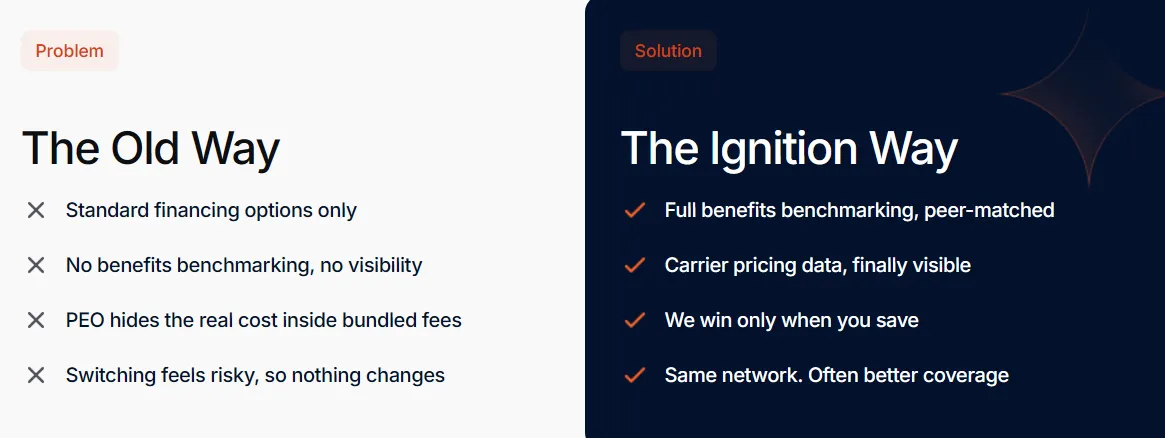
Leaving a PEO means re-registering as an employer of record in each state, setting up independent payroll, re-establishing your workers' comp policy, and sourcing benefits outside the master plan. And you’d have to do all of this on a timeline that can create coverage gaps if not managed carefully. Exit complexity is one of the biggest pros and cons of a PEO to consider.
Considering leaving your PEO? Ignition Benefits runs a full-market comparison so you can see what your team would cost outside the bundle, then manages the transition so coverage never lapses. See your cost breakdown.
What an ASO Is Good At
An ASO works best for companies with existing HR capacity that want administrative support without outsourcing control. It’s also best for companies that self-fund benefits or work with their own broker and organizations that want full cost visibility at renewal.
Because the company remains the employer of record, it can change brokers, redesign benefits, switch payroll systems, or adjust HR processes without unwinding a co-employment arrangement. That flexibility becomes more valuable as headcount grows and operational needs become more complex.
HR practitioners frequently point to the ASO model as the preferred setup for mid-size companies that have outgrown a PEO but aren't ready for a fully in-house HR function.
Where ASOs Have Limitations
An ASO is not the right fit for every company, and it’s important to be aware of the limitations.
1. More Administrative Complexity
You remain accountable for every state registration, payroll tax filing, and employment law obligation. For a company operating across many states without an HR team, that's a burden you can’t ignore.
2. Weaker Benefits Buying Power at a Small Headcount
A PEO's master plan can give smaller companies access to pricing and plan options they might not be able to secure independently. An ASO has no pool, so your pricing depends heavily on having a broker who actively shops the market for competitive plans on your behalf.
Side note: A broker is only useful if it shops the whole market, not two plans from a preferred carrier. Ignition Benefits runs a full-market audit with every dollar of compensation disclosed, and the average client saves 20% in year one. See your open-market cost.
3. Compliance liability stays with you entirely
An ASO supports compliance without actually sharing it. All it can do is flag deadlines, provide guidelines, and send reminders. This is different from having a PEO that takes responsibility for meeting compliance.
When It's Time to Leave Your PEO
The PEO model starts to lose its value as your company scales, but that crossover point is (often intentionally) hard to see. These signals tell you when it’s time to consider PEO alternatives:
- You're exceeding 50 employees, the point where the PEO's pooled pricing starts working against a healthy team and your headcount is large enough to take your own plan to the open market.
- Your renewal increase outpaced your headcount growth. A 15% premium hike on a workforce that didn't materially change in age, location, or health status is almost always a pricing signal.
- You're seeing the same 2 to 3 plan options every year from the same carrier with no evidence anyone went to full market on your behalf.
- You've never seen a benefits risk score. Every carrier has one on file for your workforce. If your broker has never surfaced it, they're not working for you.
What a real renewal negotiation looks like — and why yours wasn't one.
Ready to see what benefits would cost outside your PEO? Ignition Benefits runs a full-market comparison with complete fee transparency. Get your cost breakdown.
How Ignition Benefits Fit Into This Decision
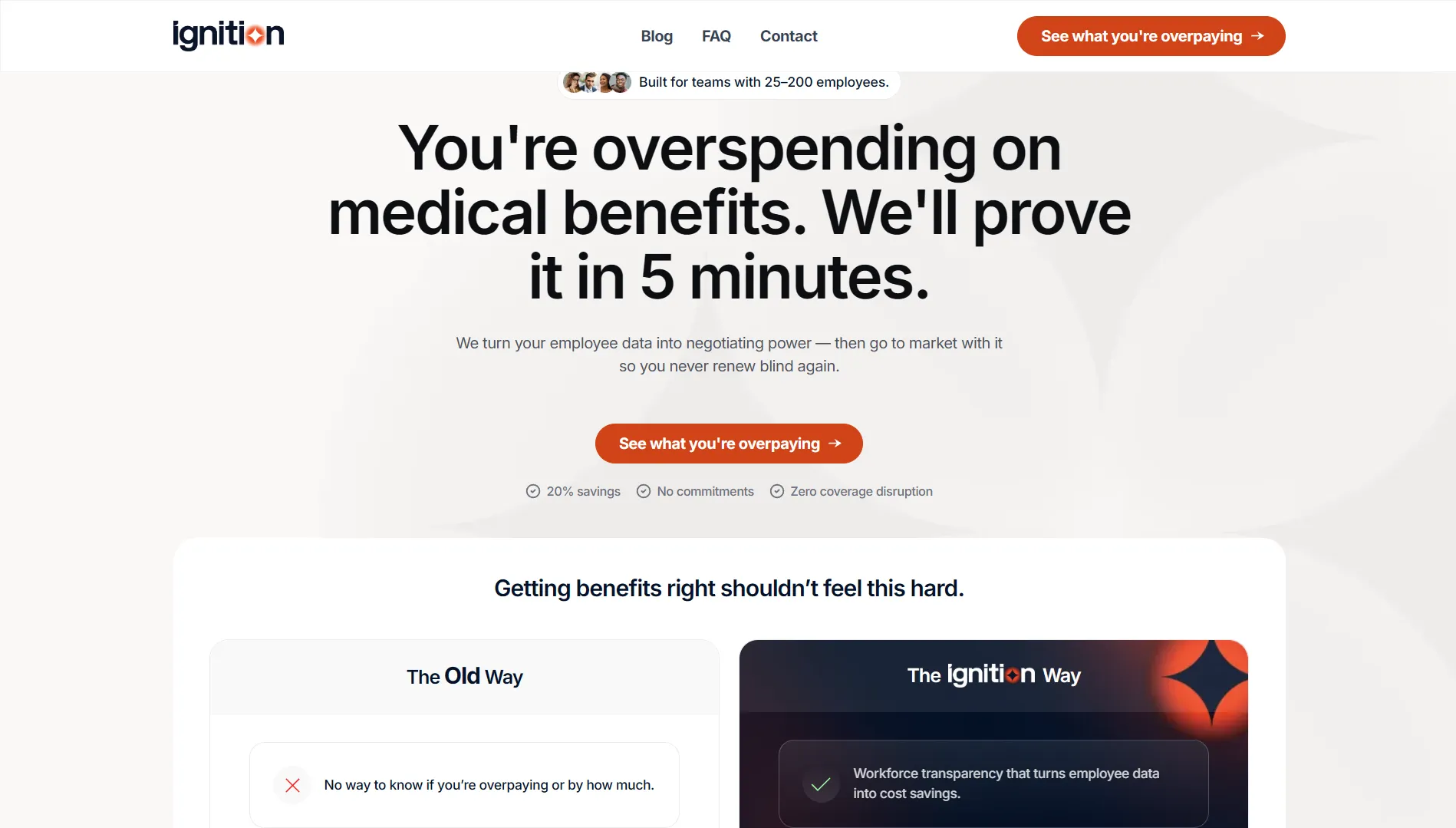
Ignition Benefits is neither a PEO nor an ASO. It's an independent benefits broker that runs a full-market audit at every renewal with no preferred carriers, surfaces the carrier risk score most founders never see, and discloses every dollar of its own compensation from day one.
The quality of the broker relationship often matters more after a company leaves a PEO. A broker that regularly markets the plan, compares carriers, and explains renewal changes preserves many of the advantages companies wanted when they moved to a more independent structure.
That's the gap Ignition is built to close. Because you see the risk score behind your pricing and every option side by side, a renewal increase stops being a number you either accept or fight blind. You can check it against your workforce's actual risk, weigh a different funding structure, or move carriers, with the full picture in front of you.
See your carrier risk score and what it should be costing you.
ASO or PEO: Either Way, Don't Renew Blind
Whether you stay on a PEO, move to an ASO, or work with an independent broker, the most expensive mistake is letting your plan auto-renew without a full-market bid.
If you're on a PEO, ask for your workforce's carrier risk score. If they won't provide it, that's your answer. If you're evaluating an ASO, ensure the benefits broker you pair with actually goes to market on your behalf rather than showing you two or three options from a preferred carrier.
If neither of those descriptions fits your current situation, Ignition runs the full analysis in 14 to 21 days with no disruption to your employees.
FAQs
What Is a PEO?
A PEO (Professional Employer Organization) enters a co-employment relationship with your business. It handles functions such as payroll, benefits administration, workers' compensation, and compliance, while you continue managing employees and day-to-day operations.
What Is an ASO?
An ASO (Administrative Services Organization) provides payroll processing, HR administration, benefits management, and compliance support without co-employment. You remain the sole employer of record throughout, with direct control over carrier relationships, plan design, and cost structure.
Can You Use an ASO and an Independent Benefits Broker at the Same Time?
Yes. This is actually the recommended setup. The ASO handles HR administration; the broker handles your benefits strategy, carrier negotiations, and renewals. The two work in parallel without any structural conflict.
What Happens to Employee Benefits When You Leave a PEO?
Your current health plan ends when you exit the PEO's master policy. Coverage doesn't transfer automatically, so you need a new plan in place before the exit date. Working with a broker well in advance is essential.
Is an ASO Cheaper Than a PEO?
Generally, yes, on the administrative fee alone. Total cost depends on what you pay for benefits independently, but a well-negotiated broker arrangement often beats a PEO bundle, particularly for companies with favorable group demographics.
Do Employees Notice a Difference Between a PEO and an ASO Setup?
Usually not. Most differences are administrative and happen behind the scenes. If the transition is managed properly, employees often see little or no change in their day-to-day experience.
How Do You Know if You’re Overpaying Through Your PEO?
One major sign is that you can't see your benefits cost separately from the administrative fee. A full-market comparison through an independent broker answers that question directly.



_%20Which%20One%20Wins%20for%20Your%20Team_.webp)

![How to Reduce Small Business Health Insurance Costs [2026]](https://cdn.prod.website-files.com/69f22330e53a32bb7629af15/6aa04b2f5dbdf3dc6b28b351_How%20to%20Reduce%20Small%20Business%20Health%20Insurance%20Costs%20%5B2026%5D%20(1).webp)
.webp)




.webp)



.webp)

.webp)








.webp)





.webp)








.webp)




.png)

