.svg)

.svg)


.webp)

- Ignition Benefits is the strongest Gusto alternative if rising health insurance costs are your main concern. Ignition is an independent benefits broker that helps you secure the same or better benefits coverage at a lower cost by calculating your workforce's risk score and using that as leverage to shop the market.
- Rippling is recommended for founders who want HR, payroll, IT, and finance in one system, with an optional PEO layer they can opt in to when co-employment makes sense.
- BambooHR is another Gusto competitor best suited for companies that need a dedicated HRIS instead of a lightweight platform.
- Justworks, Deel, ADP TotalSource, and TriNet are all PEO options for founders who want to manage HR, benefits, and finance through a co-employment model.
If you're searching for Gusto alternatives, you're either evaluating payroll/HR tools before committing to one or you’re already using Gusto and realizing it’s not the right fit anymore. Either way, this article will help you move forward with clarity.
We’ve reviewed seven of the strongest Gusto alternatives, focusing on how they outperform Gusto, what they do well and where they fall short, and how deep their features go in practice.
Top 7 Gusto Alternatives: At a Glance
1. Ignition Benefits: Best for Lower-Cost Benefits Without Co-Employment
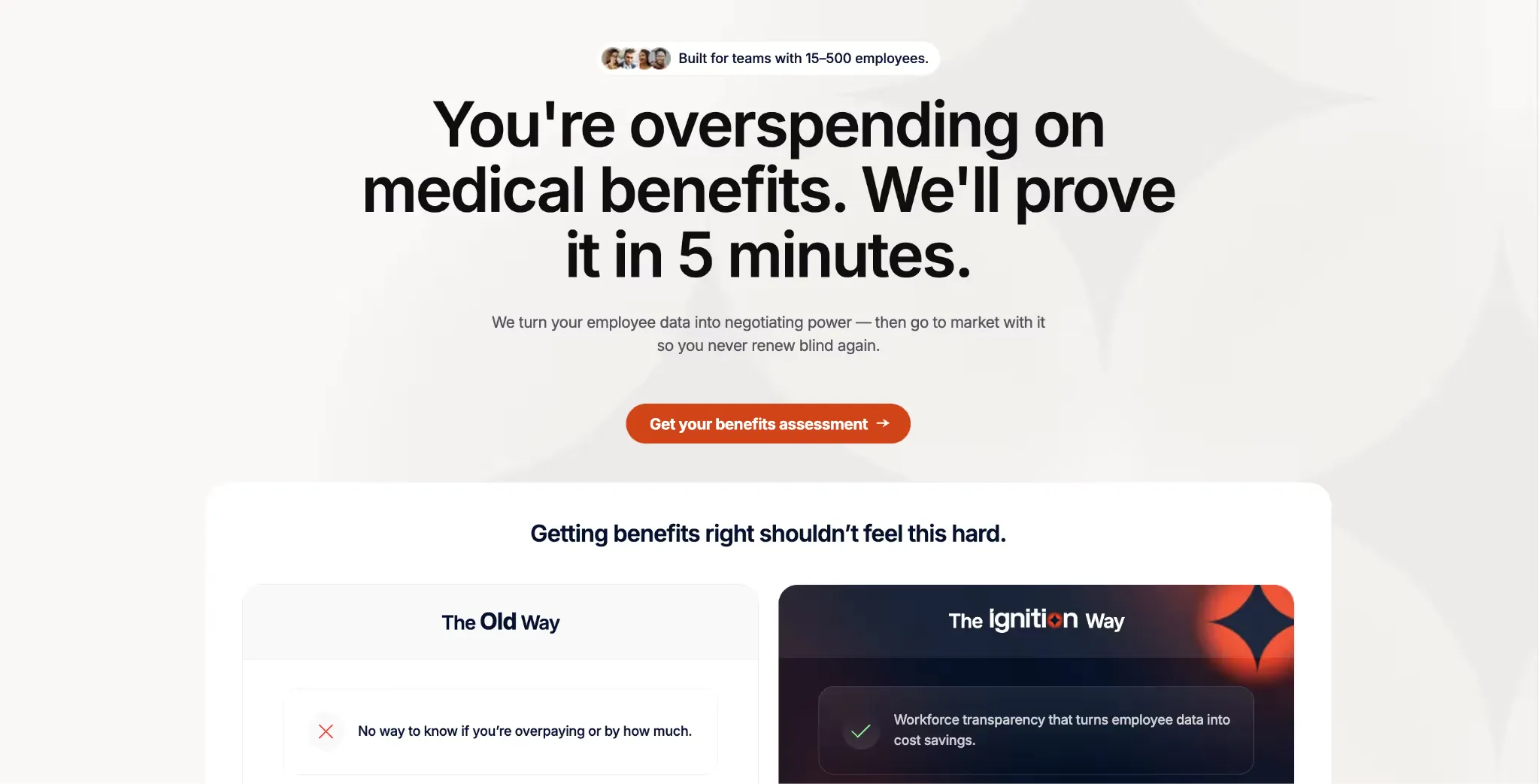
Gusto acts as a benefits broker and administers health insurance, but it doesn't share the risk score driving your insurance premium, and doesn't disclose what it earns from carriers. You get a plan, but rarely get an explanation of whether it's the right one for you.
Working with specialized advisory partners offers distinct advantages, and understanding the benefits of consulting firms can help you decide if an independent broker is right for your business.
Ignition Benefits was built to fix that. Ignition is an independent employee benefits brokerage for companies with 10-500 employees. Its main focus is on giving founders clear, transparent insight into whether what they’re paying for health benefits is justified.
Ignition Benefits Key Features
Benefits Risk Score and Full Market Audit
Every insurance carrier scores your workforce before quoting you a premium. However, most founders have never seen that score. Ignition shares it upfront, then runs a competitive bid across every available carrier and plan. The audit also includes a funding structure review (fully insured, level-funded, or self-insured), so you can compare choices most Gusto users don’t typically see.
These options can also help when you're looking at ways to reduce small business health insurance costs.
Benefits Analysis Report
Ignition delivers a full benchmarking report in 14-21 days, versus 8-12 weeks with a traditional broker. It breaks down how your current plan compares to other available options in clear language, so founders can weigh the trade-offs confidently.
Zero Carrier Runaround
Once you decide to move forward, Ignition manages all carrier interactions, including calls, paperwork, negotiations, and follow-ups. You review the plan once, while Ignition handles everything else so you don’t have to chase carriers for quotes or forms.
Ignition Benefits Pricing
Ignition doesn’t charge employers a penny. It earns through carrier commissions like other brokers and discloses those commissions upfront.
Where Ignition Benefits Shines
- Data-first approach: Ignition assesses your workforce’s benefits risk score and uses it to negotiate better rates on the same or improved coverage.
- No platform disruption: A single Broker of Record letter switches your benefits to Ignition. You can continue using Gusto or any other platform alongside it.
Where Ignition Benefits Falls Short
- Benefits only: Ignition focuses exclusively on health benefits and goes deeper into it than the other platforms on this list. For payroll, HRIS, or compliance support, you'll need a separate platform, like Rippling or BambooHR.
Who Ignition Benefits Is Best For
- Founders at 10 to 500 person companies who own benefits decisions and want clarity on what they’re actually paying for.
- Gusto customers who are frustrated with rising insurance premiums and want to look for a cost-effective solution.
Find out if you're overpaying for benefits. Get your free assessment today →
2. Rippling: Best for Founders Who Have Outgrown Gusto's Platform
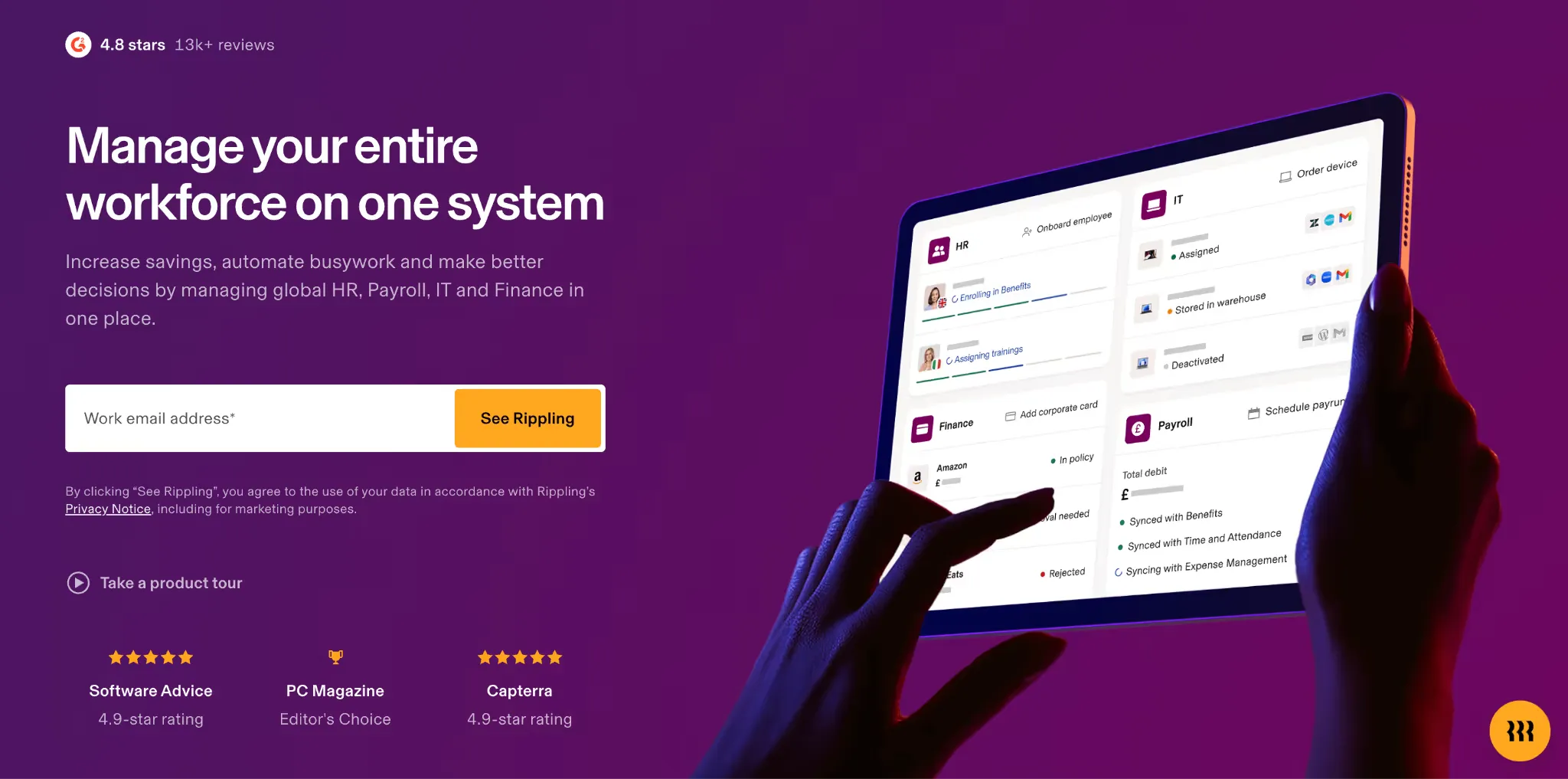
Rippling is built for companies that want HR, payroll, IT, benefits, and finance managed in one place. Unlike Gusto, which started as a payroll tool and added HR features over time, Rippling was designed from the ground up as a full workforce operating system.
On top of that, it offers an optional PEO, which gives companies access to group health rates, compliance support, and workers' compensation through a co-employment model.
Key Features
- Full-service payroll: Multi-state payroll across all 50 states, automated tax filings, W-2 preparation, and direct deposit.
- IT management: Device setup for new hires, access provisioning, and account removal for exits - all managed in one platform.
- Optional PEO layer: Co-employment is opt-in. Group benefits, compliance, EPLI, and workers' compensation are included when enrolled.
- Finance and expense management: Company cards, expense tracking, and reimbursements in the same system as payroll.
Pricing
Rippling doesn’t list its pricing publicly. Reach out to their team for a custom quote, or review our detailed guide on Rippling pricing to learn more about their cost breakdown.
Where Rippling Shines
- Operational depth: HR, payroll, IT, and finance in one system. It is a meaningful upgrade for companies that have outgrown Gusto's scope.
- PEO flexibility: The PEO is optional and can be added or removed based on your needs. Unlike Gusto, benefits aren’t built into the platform in a way that locks you in.
Where Rippling Falls Short
- No benefits market audit: Like Gusto, Rippling presents health plan options from its carrier pool at renewal without a full market bid or risk score disclosure.
- Complex onboarding: G2 reviewers flag implementation as a pain point for teams without a dedicated HR or operations person.
Who Rippling Is Best For
- Startups that want HR, IT, and payroll in one system, with the option to add a PEO layer when it makes sense.
3. BambooHR: Best for Companies That Need a Dedicated HRIS
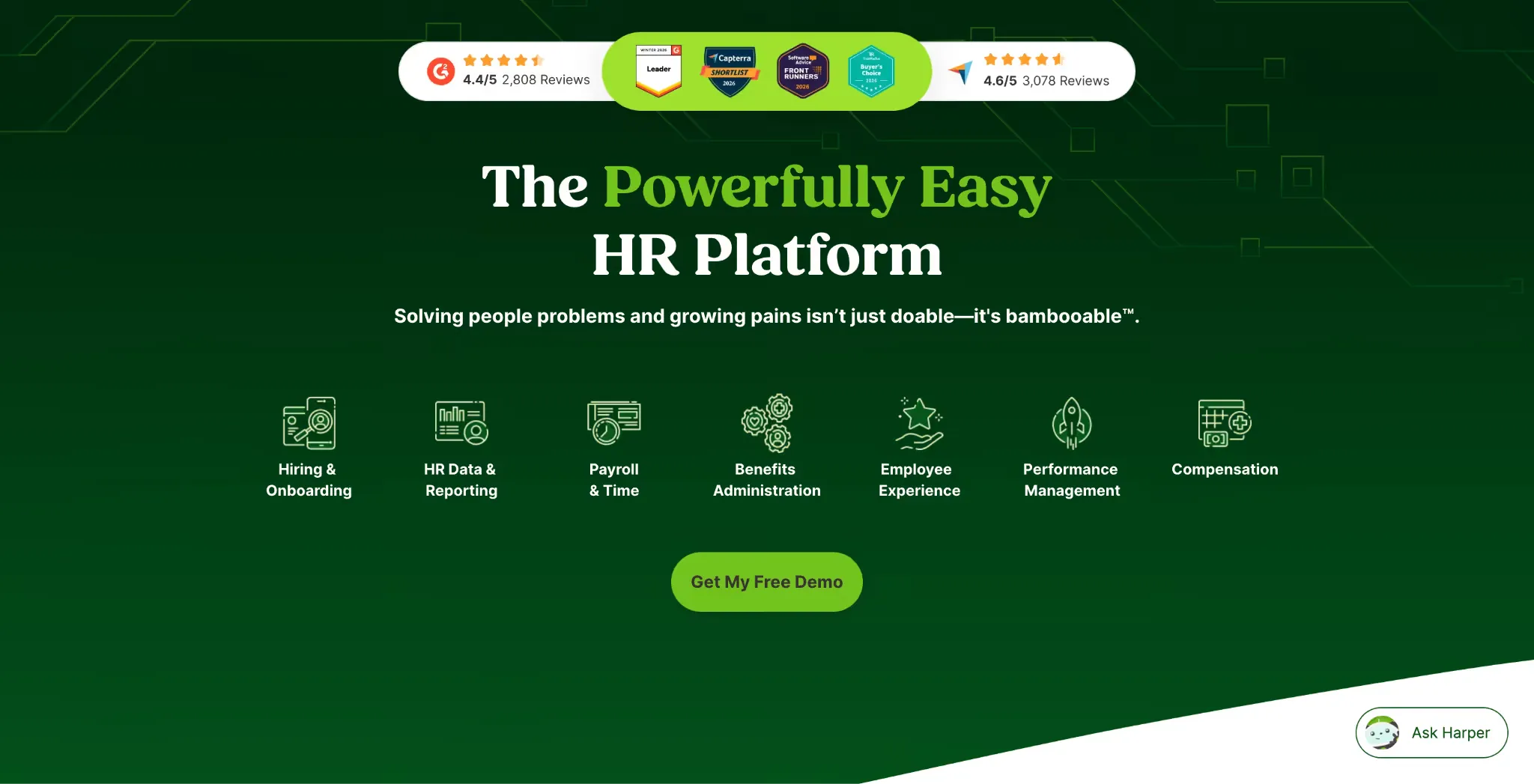
Gusto is a payroll-first platform and that shows in its HR layer. Performance management, reporting, and compensation benchmarking all come with extra fees and limited functionality. For a small team, that's workable, but as a company scales, those gaps add up fast.
BambooHR is built the other way around. It is a dedicated HRIS trusted by over 34,000 businesses with HR as the core product and payroll as the add-on.
Key Features
- Performance management: Peer feedback, goal tracking, and structured review cycles on the Pro plan.
- Compensation planning: Salary bands, Mercer-powered benchmarking, and review workflows.
- Hiring and onboarding: Built-in ATS, job posting to major boards, and automated onboarding checklists.
- HR reporting: Pre-built and custom reports, automated workflows, and an AI-powered HR assistant pulling from live data.
Pricing
Where BambooHR Shines
- HRIS depth: Performance management, compensation benchmarking, and advanced reporting are provided without extra fees. These tools give HR teams clear data to make better decisions on pay, performance, and hiring.
- Dedicated implementation: BambooHR assigns a hands-on implementation manager from day one, unlike Gusto, which is self-service until you pay for a higher support tier.
Where BambooHR Falls Short
- Not a PEO: No co-employment or built-in group benefits negotiation, so you’ll need a separate broker or PEO to handle that layer.
- Multiple add-ons: Payroll, benefits administration, and time tracking are not included natively and require add-ons. For companies that need them, costs can add up quickly.
Who BambooHR Is Best For
- SMBs that have a dedicated HR function and need a deeper people operations tool than Gusto.
4. Justworks: Best for Early-Stage Teams Wanting a Simple PEO
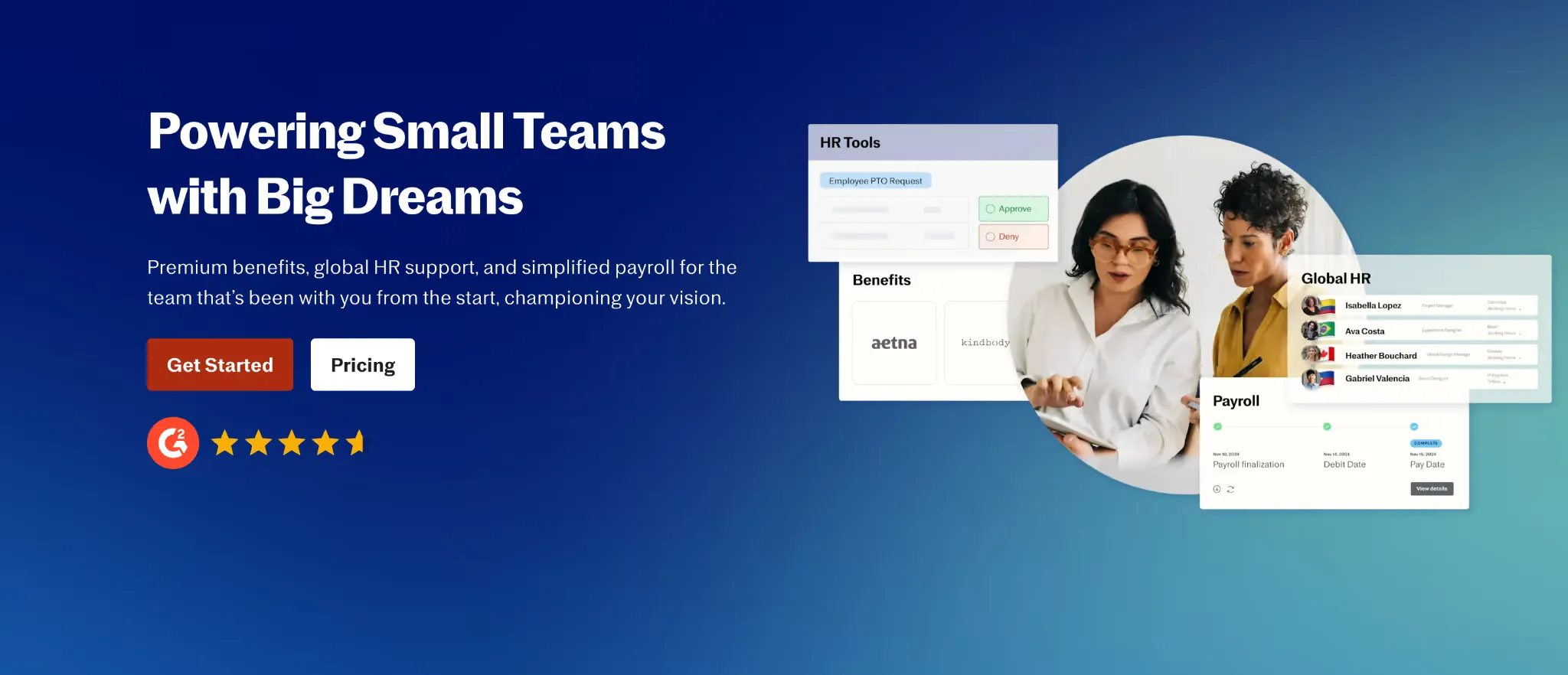
Justworks goes beyond Gusto’s scope by offering a co-employment model. This gives employees access to group health rates that small companies can’t usually secure on their own. Unlike many PEOs, it also stands out for pricing transparency with publicly listed rates.
Key Features
- Co-employment and group benefits: Medical, dental, vision, and 401(k) through Justworks' carrier pool under the co-employment arrangement.
- Payroll and compliance: Multi-state payroll, tax filings, workers' compensation, and EPLI included.
- HR tools and reporting: Justworks centralizes HR administration and replaces manual spreadsheet work with integrated reporting.
Pricing
See how Gusto vs Justworks compares on pricing.
Where Justworks Shines
- Pricing transparency: Publicly listed rates make it easy to budget without going through a sales process.
- Simple onboarding: Justworks is known for a straightforward setup experience that gets teams running quickly.
Where Justworks Falls Short
- No benefits market audit: Justworks doesn't run a competitive bid at renewal or share your workforce's risk score, unlike Ignition Benefits.
- Limited HRIS: Basic HR features can feel restrictive for teams that need deeper insights or more control over HR workflows.
Who Justworks Is Best For
- Early-stage teams who want a transparent PEO with group health access and a fast setup.
If you want to evaluate other PEO options, check out our guide to Justworks alternatives.
5. Deel: Best for Companies Hiring Across Borders
Gusto supports international contractor payments in over 120 countries, but its EOR offering relies on a third-party partner instead of in-house infrastructure.
Deel takes a global-first approach, managing US employees and international hires in one system, with its own EOR coverage across 150+ countries.
Key Features
- US PEO with co-employment: Payroll, tax filings, benefits, and compliance for US employees, with the option to retain your existing benefits broker.
- Global EOR: Full-time employees in 150+ countries hired through Deel's own infrastructure, not third-party partners.
- Contractor management: International contractors managed and paid in local currency on the same platform as US employees.
Pricing
For a detailed breakdown of plan tiers and cost considerations, read our guide on Deel pricing.
Where Deel Shines
- One platform for global and US teams: US PEO and international employment in one system.
- Broker flexibility: Deel allows you to retain your existing benefits broker.
Where Deel Falls Short
- Cost at scale: EOR fees compound fast across a large international workforce.
Who Deel Is Best For
- Companies managing US employees and international hires who want both handled from one platform.
6. ADP TotalSource: Best for Companies Wanting Enterprise Benefits Access
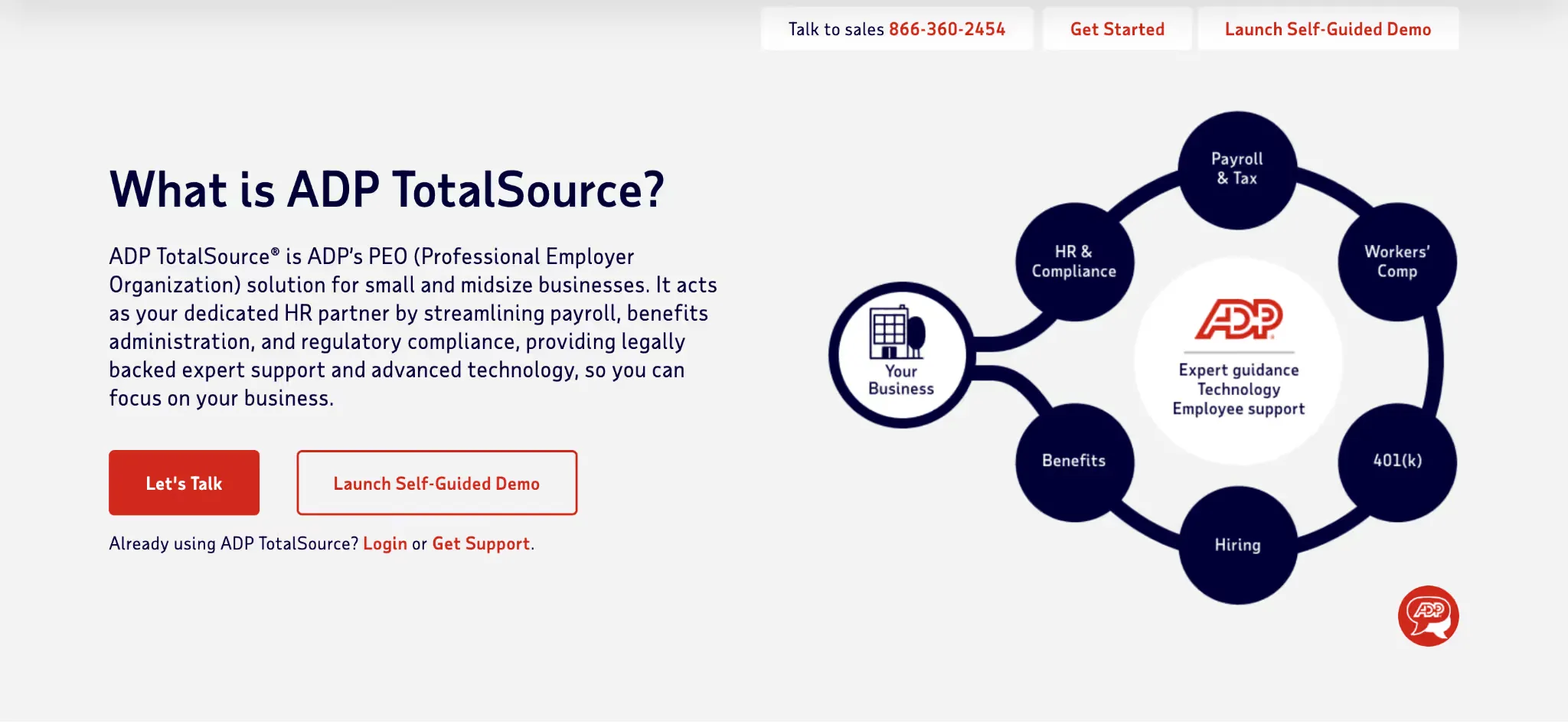
ADP TotalSource is a certified PEO with 722,000+ worksite employees, giving it strong leverage in benefits negotiations. Clients get a dedicated HR business partner and access to ADP Assist, an AI tool that provides real-time workforce insights. It fits companies with 50 to 500 employees that want enterprise-grade benefits and hands-on support.
The tradeoff is cost, with reviewers often pointing to higher admin fees. At renewal, benefits typically stay within the existing carrier network, rather than being re-bid across a broader market for comparison.
7. TriNet: Best for SMBs in Specialized Industries

TriNet is another certified PEO with around 338,900 worksite employees. Its main differentiator is industry focus, with dedicated HR advisor teams for sectors like technology, financial services, nonprofits, and professional services.
For companies in specialized industries where generic HR support isn’t enough, this vertical expertise can be a real advantage. Like other PEOs, it doesn’t run a full market-wide benefits review at renewal and doesn’t share the benefits risk score with founders.
Pricing is custom and available on request.
If you want to compare other options, check out our guide to TriNet alternatives. Pricing is custom and available on request.
Reasons to Consider a Gusto Alternative
Gusto works well when your company is small. But as your team scales, the platform doesn't always keep up. Here are the most common reasons founders start looking for an alternative to Gusto.
No Access to Group Buying Power
Because Gusto is not a PEO, it doesn’t pool employees across companies to access large-group health rates. Each business is quoted separately in the small-group market, where carriers largely control pricing and leave little room to negotiate.
For younger, healthier teams, this often means higher spend than necessary. Your workforce likely carries a low risk profile, which should translate into lower premiums, but without that data being measured and used in negotiations, you end up renewing at the carrier’s standard rate.
Ignition Benefits takes a different approach. It uses your team’s risk profile to negotiate across carriers and secure pricing based on your actual cost, not a market average.
Coverage Gaps When You Hire in New States
Clara M., a Gusto customer, shares, “The issue with Gusto is that some of the benefit offerings are not available everywhere. As we ventured in new states we realized that not every health insurance scheme was offered.”
Expanding into a new state should be straightforward. But Gusto's health insurance availability is tied to its carrier relationships and those don't cover every state equally. Companies that have hired in new states have found that the plan their team was on simply isn't offered there, forcing them to patch together coverage or manage benefits outside the platform.
Ignition Benefits approaches this differently. Because it's not tied to any single carrier or platform, Ignition evaluates what's available across the full market in every state your team operates in to find coverage that works for your entire workforce.
Customer Support That Doesn't Scale With You
As your team grows, HR questions get more complex: multi-state compliance, mid-year benefits changes, tax filings, etc. That's exactly when you need fast, knowledgeable support.
Gusto's support model works reasonably well for simple questions, but breaks down on anything complex. There's no dedicated contact, support is split across different teams depending on the issue, and resolution times on technical or benefits-related matters can drag on for days.
For founders handling HR on their own, this gets hard to manage, especially during busy times like open enrollment or onboarding.
Upgrade Your Benefits Without Replacing Your Entire Stack
Before deciding which platform to switch to, it's worth separating the problem from the solution. If payroll is running smoothly on Gusto but benefits costs are climbing, you don't need to replace the whole platform, just the benefits layer.
Every alternative on this list addresses a different gap. But none of them independently audit what you're paying for health insurance, except for Ignition Benefits.
Ignition sits alongside your existing platform, uses your team's actual risk data to bid across every available carrier, and delivers a full benchmarking report in 14-21 days - at zero cost to the employer.



_%20Which%20One%20Wins%20for%20Your%20Team_.webp)

![How to Reduce Small Business Health Insurance Costs [2026]](https://cdn.prod.website-files.com/69f22330e53a32bb7629af15/6aa04b2f5dbdf3dc6b28b351_How%20to%20Reduce%20Small%20Business%20Health%20Insurance%20Costs%20%5B2026%5D%20(1).webp)
.webp)




.webp)



.webp)

.webp)









.webp)





.webp)







.webp)




.png)

