.svg)

.svg)


.webp)

- In a fully-funded plan, the carrier assumes all claims risk in exchange for a fixed monthly premium. The cost stays the same whether your team files ten claims or a hundred.
- In a self-funded plan, the employer pays claims directly. Stop-loss insurance caps exposure on catastrophic claims, and a TPA handles day-to-day administration.
- Self-funding works best for companies with 50+ employees and becomes an even stronger fit at 100+, particularly for young, healthy teams with cash reserves and founders willing to keep an eye on claims data.
- Fully-funded health insurance works best for companies under 100 employees, with uneven cash flow, or with high-cost claimants in their workforce.
- Ignition Benefits takes the guesswork out of the funding structure decision by pulling your Benefits Risk Score, auditing the full market, and delivering a clear recommendation based on your specific workforce data.
For many companies, health insurance is one of the largest line items on their P&L, but most founders have little visibility into what drives those costs. A large part of that comes down to one decision that rarely gets explained properly: the funding structure behind the plan.
This article breaks down the difference between two popular funding structures: self-funded and fully-funded health insurance. It explains how each model works and helps you decide which structure best suits your company.
Self-Funded vs Fully-Funded Health Insurance: Quick Comparison Table
Self-Funded vs Fully-Funded: Key Differences
The difference between self-funded and fully-funded health insurance is not only financial. It shapes who owns the data, who controls plan design, and who benefits from a healthier workforce.
Each of the six factors below has a real dollar consequence for your company.
1. Who Assumes the Risk
In a fully-funded plan, the carrier prices your premium based on its estimate of what your workforce will cost to cover, and assumes the financial risk. If actual claims come in lower than expected, the carrier retains the surplus, and the employer does not benefit from any savings.
In a self-funded plan, that risk sits with the employer. The company pays for claims as they happen, and when usage is lower than projected, the savings remain within the business.
Carriers evaluate companies by calculating the Benefits Risk Score, which is based on the age, gender, and location of the workforce. When that score is low and premiums are high, the employer is subsidizing the carrier's higher-risk clients. Self-funding changes that dynamic by tying cost directly to real claims.
2. Cost Structure and Predictability
Fully-funded plans offer predictability: one fixed premium per employee per month, set at the start of the plan year. The carrier builds its margin into that number, and the cost stays the same whether your team files ten claims or a hundred.
Self-funded plans work differently. You pay claims as they occur, which means costs vary month to month. To manage that variability, most employers on a self-funded plan purchase stop-loss insurance, which caps exposure if claims exceed a set threshold. Many also work with a Third Party Administrator (TPA) to handle claims processing and administration on their behalf.
Side Note: Level-funded plans sit between fully-funded and self-funded. Employers pay a fixed monthly amount to the carrier, and at year end, any unused claims funds are returned to the company. For companies that want cost predictability without giving up potential savings, level-funded insurance is worth exploring.
3. Claims Data Visibility
In a fully-funded plan, the carrier owns the claims data. Employers typically receive little to no visibility into how that data breaks down, which makes it almost impossible to understand what is driving the cost of coverage year over year.
In a self-funded plan, the employer owns the data. Every dollar spent on claims is visible and traceable. The employer can see which types of treatments are costing the most, how frequently employees are using their benefits, and whether overall spending is increasing or decreasing over time.
This level of detail serves two purposes:
- First, it allows the company to make proactive decisions about plan design, network selection, and wellness programs based on what employees are actually using.
- Second, it becomes a powerful tool at renewal. An employer armed with real claims data can have a fact-based conversation with carriers rather than simply accepting whatever number comes across the table.
4. Plan Customization
Fully-funded plans are largely standardized. The carrier designs the plan, chooses the network, and decides what is covered. Employers choose from pre-built options with limited ability to adjust for the actual needs of their workforce.
Self-funded plans let employers build coverage around the team. A software startup with a young team that rarely uses specialist care still pays for that coverage in a fully-funded plan. With self-funding, the plan reflects how the workforce actually uses care. That alignment is where much of the savings come from.
5. Regulatory Framework
Fully-funded plans fall under both state insurance regulations and applicable federal requirements: state-mandated benefits, premium taxes, and carrier compliance costs, many of which are baked into the premium without being itemized.
Self-funded plans are governed primarily by federal law under ERISA, which means most state insurance rules do not apply. Without those extra requirements, regulatory costs are lower. This is one reason self-funded plans often cost less to run than fully-funded plans.
6. Administrative Burden
Fully-funded plans are relatively straightforward to administer. The carrier handles claims processing, compliance, and most of the paperwork. For founders without a dedicated HR team, it means less day-to-day operational work.
Self-funded plans require more active management. Employers are responsible for claims oversight, compliance, and reporting.
Most companies use a TPA who handles the administrative work needed to keep the plan running smoothly. Without one, the admin burden of self-funding would be high for most growing companies.
When Self-Funding Is the Right Choice
Self-funded health insurance works best for companies that fit this profile:
- Around 50+ employees, with a strong fit for organizations with more than 100 employees
- A workforce that skews young and healthy
- Sufficient cash reserves to handle variations in monthly claims costs
- A founder or operator willing to monitor claims data
- Companies approaching 50 employees on a PEO, where pool pricing is increasingly working against them
Self-funding is not a right fit for companies without enough headcount to spread claims risk, workforces with major chronic illnesses or high-cost claimants, or founders who want to fully outsource health benefits.
When Fully-Funded Is the Right Choice
Fully-funded insurance works best for:
- Companies under 100 employees that want predictable, fixed monthly costs
- Businesses without steady cash flow to absorb variations in claims costs
- Companies with limited HR capacity to manage a self-funded plan
- Workforces with chronic illnesses or high-cost claimants where claims variability is a real risk
That said, many companies sit in a gray zone. They have a workforce that could support self-funding but have never been shown the data to confirm it. That is exactly where an independent broker assessment, one that looks at the actual Benefits Risk Score and runs a full comparison across both funding structures, gives the company what it needs to make the right call.
How a Benefits Broker Helps You Choose and Implement the Right Model
The difference between self-funded and fully-funded health insurance looks clear in a comparison table.
In practice, the right answer comes down to data most founders don’t usually see: their workforce’s real risk profile and how their current premium stacks up against a plan designed for their team.
The right broker starts with your Benefits Risk Score before going to the market. This gives you a clear view of how carriers view your workforce risk before renewal quotes come in. From there, they map the full market (carriers, plan designs, and funding structures), and benchmark your per-employee cost against similar companies so you know where you stand.
Most traditional brokers do not run this analysis. Their compensation is tied to premium size, which means there is little incentive to reduce spend or fully explore alternative structures.
Ignition Benefits is built around the opposite model. It runs a full-market audit at every renewal, discloses all compensation upfront, and avoids preferred carrier arrangements. Within 14-21 days, you get a complete view of available carriers, funding options, and a recommendation grounded in real numbers.
Implementation matters as much as selection. Whether you are moving off a PEO or switching from an existing broker, Ignition manages the transition using a single document: the Broker of Record letter. Employees keep their existing coverage without any disruption.
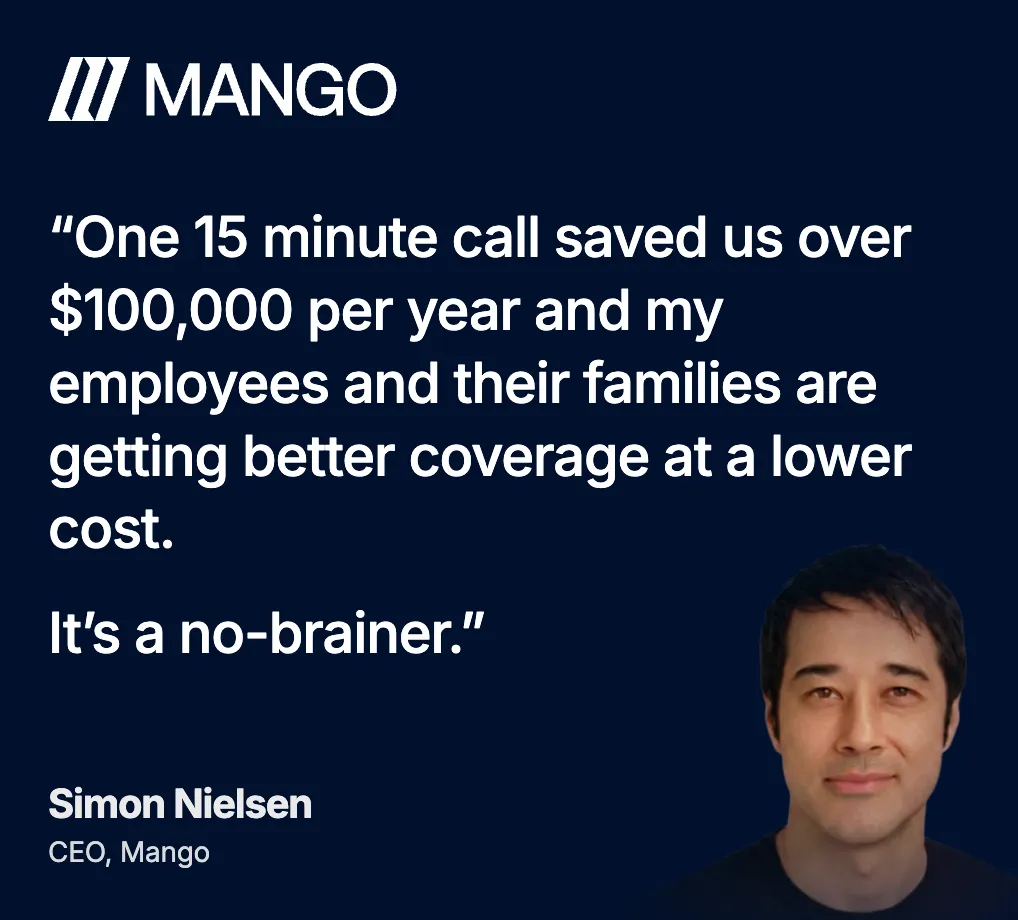
Simon Nielsen, CEO of Mango, weighed in on the value Ignition brings:
See Which Model Saves Your Company More
The difference between fully-funded vs self-funded insurance is not the same for every company. It depends on your workforce size, health profile, and how your current plan is structured. The only way to know which model works in your favor is to look at your specific risk profile.
Ignition pulls that data and runs a full-market audit in just 14-21 days. See which funding structure is the right fit for you.
FAQs
What is a fully-funded health insurance plan?
A fully-funded health insurance plan is one where the employer pays a fixed monthly premium to a carrier, which assumes responsibility for covering employee claims. Any unused claim funds are not returned at year end.
What is a self-funded health insurance plan?
A self-funded plan is one where the employer pays medical claims directly as they occur. The employer takes on claims risk but purchases stop-loss insurance to cap exposure on large or catastrophic claims.
Is self-funded health insurance riskier than fully-funded?
Yes, self-funded plans carry more financial risk. That risk is usually managed through stop-loss insurance. For companies with healthy, low-risk workforces, the long-term savings often outweigh the short-term risk.
What is the minimum company size for self-funding?
Self-funding is typically considered viable starting at around 50 employees.
Can a small startup use a self-funded health plan?
Sometimes. Startups with 50 or more employees, a younger workforce, and a low Benefits Risk Score are often strong candidates for self-funding. The key factor is employee demographics. When a company has a healthier-than-average workforce, it is often overpaying on a fully-funded plan and can reduce costs by moving to a self-funded structure.



_%20Which%20One%20Wins%20for%20Your%20Team_.webp)

![How to Reduce Small Business Health Insurance Costs [2026]](https://cdn.prod.website-files.com/69f22330e53a32bb7629af15/6aa04b2f5dbdf3dc6b28b351_How%20to%20Reduce%20Small%20Business%20Health%20Insurance%20Costs%20%5B2026%5D%20(1).webp)
.webp)




.webp)



.webp)

.webp)








.webp)





.webp)








.webp)




.png)

