.svg)

.svg)

.webp)
.webp)

- Test any broker on four things: whether they show you your workforce risk score, whether they run a full market audit, which funding structures they model, and who answers employee questions between renewals.
- Start 90 to 120 days before your renewal. Pull your census and plan documents first, then send every candidate the same brief so their answers can be compared.
- Three signals say the relationship has stopped working: a large increase with no stated cause, approaching 50 employees on a PEO, and three years of quotes from a single carrier.
- Switching brokers takes one document. A Broker of Record letter changes who represents you, and your coverage, payroll, and HR system stay in place.
- Five firms serve companies in the 10 to 500 employee range: Ignition Benefits, Nava Benefits, Bennie, Sequoia, and OneDigital. Ignition Benefits works with founder-led US companies and shares the risk score carriers already hold on your workforce.
Your renewal came in 18% higher, and no one gave you a proper explanation for the increase.
That is the point at which most small businesses start searching for benefit brokers. However, the firm you pick matters less than the process that firm runs.
Below is a checklist for evaluating brokers, a step-by-step selection process, the signals that it is time to replace your current one, and five providers that work with companies in the 10 to 500 employee range.
How to Choose a Benefits Broker for Your Small Business
Four things separate a broker who lowers your spend from one who forwards you an unexplained renewal notice. Test every candidate against all four before you sign anything.
1. Whether They Show You Your Workforce Risk Score
Every carrier scores your workforce before it quotes your renewal. The score is built from the age, gender, and location of your team, and it decides the number you are eventually shown.
Most employers never see that score. Without it, you cannot tell whether a 15% increase reflects your own workforce or a pricing decision the carrier made across its whole book of business.
Ask each candidate whether you will see your risk profile before they go to market. Then ask what they do with it once they have it, because a broker working from that score can argue against an increase using the carrier's own numbers.
Ignition Benefits pulls the score and shares it with you before any carrier is approached
2. Whether They Run a Full Market Audit
Ask any broker what shopping the market means to them. Many will describe pulling two or three quotes from carriers they already work with, which is a market check rather than an audit.
A real audit sends your census to every carrier that will write your group. It puts the responses on comparable terms and reviews funding structure alongside carrier choice. It happens at every renewal rather than once at the start of the relationship.
For small employers, the cost of skipping this is measurable. KFF's 2025 Employer Health Benefits Survey found that covered workers at firms with 10 to 199 workers contributed an average of $8,889 a year toward family coverage against $6,227 at larger firms, which means your employees carry roughly $2,600 more each year than they would at a large employer.
The same survey put the average single deductible at $2,631 in small firms against $1,670 in large ones. Without a genuine bid, you have no way to know whether your quote reflects your workforce or the market average.
Ignition runs a full market audit at every renewal with no preferred carriers and delivers the comparison in 14 to 21 days.
3. Access to Alternative Funding Structures
Most small employers are only ever shown a fully insured plan. You pay a fixed premium, and the carrier keeps whatever your team does not use in claims.
For a young, healthy workforce, that is often the most expensive option available. Other structures exist, and each one suits a different risk profile.
- Fully insured: You pay a fixed premium to the carrier, and the carrier keeps any money your team does not use.
- Level-funded: You pay a fixed monthly amount covering expected claims, stop-loss insurance, and administration. If claims come in under budget, the surplus returns to you at year end.
- Captive: Several employers pool their claims risk inside a jointly owned insurance company, which gives more control over spend without full self-insurance.
- Self-insured: You fund employee claims directly instead of paying a fixed premium, with stop-loss insurance to cap the cost of large claims.
The differences between fully insured and self-funded structures are where the largest savings usually show up, and a broker who never raises them is limiting your options.
Ask directly which funding structures they modeled for you this year and why each one was ruled out. A broker with a specific answer has done the work. One who says your group is too small for anything else is repeating something they were told.
Ignition includes a funding review in every audit and evaluates whether a level-funded or self-insured structure fits your workforce, your claims history, and the risk you are willing to carry.
4. Service Model Between Renewals
Renewal season lasts four to six weeks. The other eleven months show whether a broker earns the commission or becomes hard to reach.
Find out who answers when an employee's claim is denied in March. Some brokers route everything through a single account manager, some staff a support team, and some give employees an app so the question never reaches your inbox.
For a company without a dedicated HR person, this matters more than it sounds. Benefits questions land on whoever is closest, and that is usually a founder or an office manager with other work to do.
Ask for the response time commitment in writing, and ask how many clients the assigned team carries. Ignition handles carrier calls, forms, and follow-up directly, so the employer makes one decision and Ignition executes the rest.
Five Steps for an Ideal Benefits Broker Selection
Running a structured process is what separates a 50-person company's outcome from a 500-person company's outcome. Here is the sequence, start to finish.
Step 1: Start 90 to 120 Days Before Renewal
Deadline pressure works against you. A carrier that knows you have three weeks and nowhere to go has no reason to improve its quote.
A carrier bidding against four others, facing a buyer with time to move, prices differently. The risk has not changed, but the pressure has.
Put the date in your calendar now. If your plan year starts January 1, you should be in the market by September.
Step 2: Pull Your Own Data First
Before you talk to anyone, gather your employee census with ages, genders, and home zip codes. Add your current plan documents, your current premium by tier, and any claims or loss ratio data your carrier will release.
Fully insured groups often cannot get claims data, and that is worth knowing early. It tells you how little visibility you currently have and gives you a specific thing to ask each candidate about.
Skipping this step means every broker you speak to starts from zero. You then spend the first two weeks of your process on data collection instead of analysis.
Step 3: Send Every Candidate the Same Brief
Give each firm the same census, the same plan documents, and the same set of questions. Different inputs produce answers you cannot compare.
Set the same deadline for everyone. How each firm handles a specific request with a fixed date tells you how they will handle your renewal.
Step 4: Compare Candidates on Process
Every broker will tell you they will lower your costs. Ask them to describe how instead:
- How many carriers will you approach?
- What funding structures will you model?
- What data will you show us before we decide?
- What does the deliverable look like?
A firm with a defined process answers with carrier counts, funding structures, and dates. A firm without one answers with general claims about service quality.
Ask for a sample deliverable, and ask how long it takes. A comparable review from a legacy broker typically runs 8 to 12 weeks, which is one reason starting 120 days out matters.
Step 5: Appoint With a Single Broker of Record Letter
Switching brokers requires one document. A Broker of Record letter, often shortened to BOR letter, tells your carrier that a new firm now represents you. Your coverage and plans stay in place, and your employees notice nothing.
Your payroll and human resources information system, or HRIS, stay put as well. Companies routinely keep Gusto, Rippling, or their existing platform and change only the benefits representation.
If you are weighing a bundled PEO against a standalone broker, compare the co-employment terms and the exit terms in both contracts before you decide.
Why Should You Start Looking for an Alternative Benefit Broker?
Most companies wait too long. Three specific situations mean the relationship has already stopped working.
1. Your Renewal Increased With No Explanation
A 15% or 20% increase, explained only as market conditions, is the clearest signal there is. Market conditions do affect your renewal, and they still do not account for a number that far above trend.
KFF's 2025 Employer Health Benefits Survey put average annual family premiums at $26,993, up 6% in a year, against wage growth of 4% and inflation of 2.7%. Premiums are climbing faster than the money available to pay them, which is the backdrop every broker is working against.
A 6% average is still not a 20% quote. If your increase sits well above trend, something specific is driving it, such as claims experience, a demographic shift, plan design, pool composition, or carrier margin.
Your broker should be able to name which one and show you the data. If they cannot, they did not ask the carrier, and a second weak answer is your signal to start a search.
2. You're Approaching 50 Employees and Still on a PEO
PEO pricing works by pooling your team with every other client on the platform. Early on, that pooling helps a small company reach plans it could not buy alone.
Around 50 employees, the arithmetic turns. A healthy workforce usually starts covering the claims cost of higher-risk companies in the same pool, and the administrative fee sits on top of that inside a per-employee-per-month PEO price you cannot break apart.
You do not have to leave the PEO to fix the benefits layer. Appointing an independent broker for medical coverage while the PEO keeps running payroll and compliance is a common arrangement.
If you are considering a full exit, comparing the top PEO providers against open-market pricing is the first step.
3. Your Broker Has Never Shown You an Option Outside Your Current Carrier
Think back through your last three renewals and count the carriers and funding structures that appeared in the comparison.
If the answer is one carrier and one structure every year, your broker is renewing the same plan rather than shopping the market. That is a service level, and it is the one most small employers receive without knowing an alternative exists.
The same test applies to your risk profile. Every carrier scores your workforce on age, gender, and location before quoting, so if you have never seen that score, you are negotiating against someone holding information you do not have.
Compare the Best Benefits Brokers for Small Business: At a Glance
The table below compares five firms that work with companies in the 10 to 500 employee range. It covers who each firm suits, its standout feature, and the size of company it serves.
Ignition Benefits: Best for Founders and Teams of Up to 200 Employees
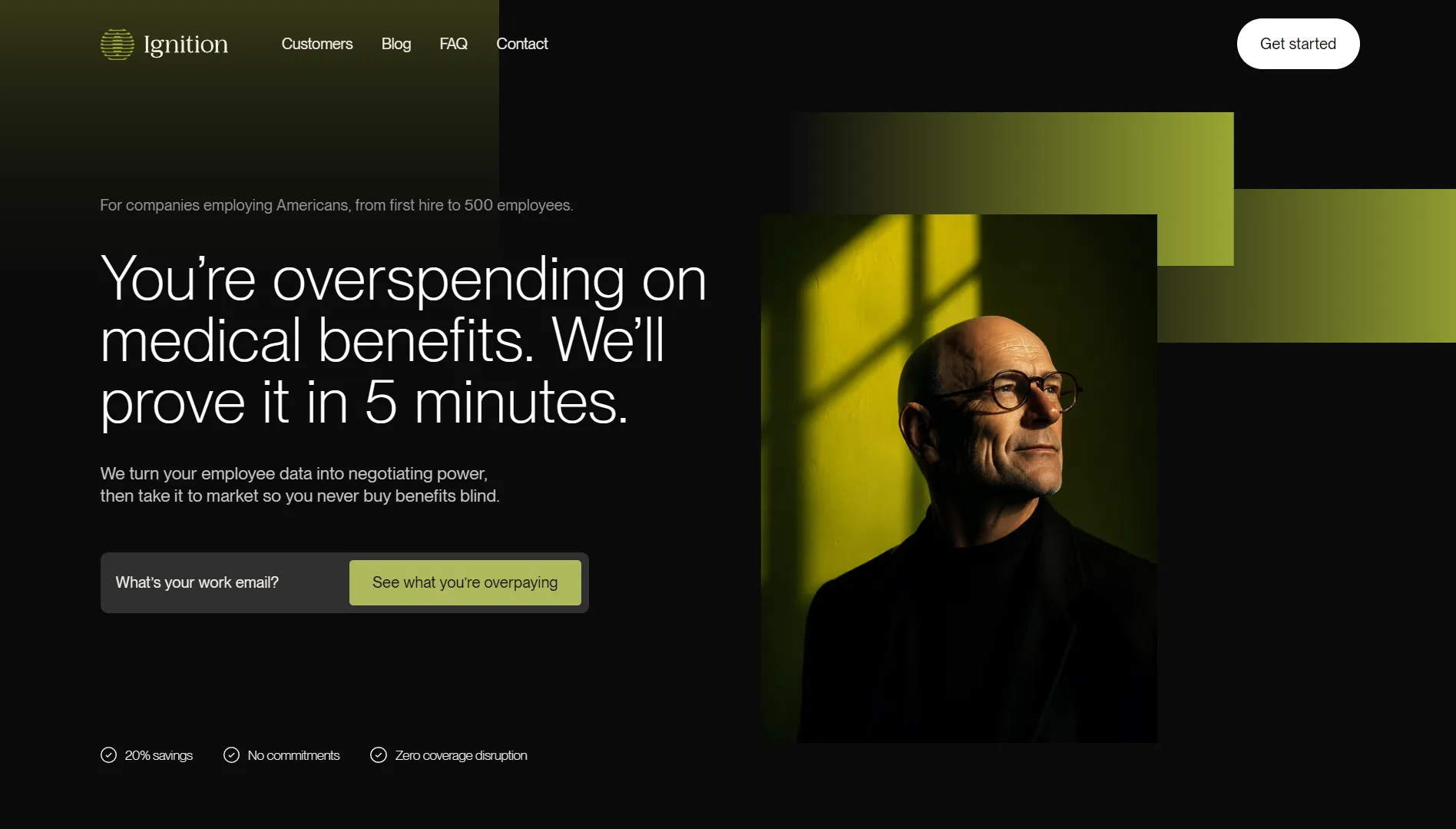
Ignition Benefits is an independent employee benefits brokerage for founders and teams of up to 200 employees. It was founded by Nick Taranto, who scaled Plated to roughly 1,500 people before its acquisition and watched brokers earn commissions on his premiums without ever running a full market review.
Ignition is paid through commissions built into the carrier's premium, with no added fee to the employer.
Key Features
Three things define how Ignition works, and each one gives the employer information the traditional model keeps on the carrier's side of the conversation.
Benefits Risk Score
Every carrier scores your workforce before quoting your renewal. The score is built from the age, gender, and location of your team, and it drives the number you are eventually shown. Employers almost never see it.
Ignition pulls that score and shares it with you before going to market. If your score is low and your premiums are high, you can prove you are overpaying rather than suspect it.
That gap is common for younger, healthier teams. It is widest inside a PEO, where individual risk is averaged into a pool.
Full Market Audit and Funding Review
At every renewal, Ignition runs your workforce data against every carrier and plan design available to your group, with no preferred carriers. Every alternative is laid out side by side with plan details, total cost, carrier, and a recommendation.
The audit includes a funding review covering fully insured, level-funded, captive, and self-insured structures. That review matters most for groups that have only ever been quoted one way.
Network is reviewed alongside cost, so employee locations and known provider preferences are checked before a plan is recommended. Your payroll and HRIS stay where they are, since only the broker relationship changes.
Two-Call Process in 14 to 21 Days
Call one is a 15-minute intake covering your census, current plan, and current premiums. Ignition then takes 14 to 21 days to run benchmarking, risk scoring, and the funding analysis.
Call two is a 15-minute review of the Benefits Analysis Report and the recommendation. If you move forward, you sign one Broker of Record letter, and Ignition takes over with the carriers.
Where Ignition Benefits Shines
- Speed without a shallower analysis: A full Benefits Analysis Report in 14 to 21 days, compared to the typical 8 to 12 weeks.
- No platform disruption: One Broker of Record letter. Payroll, HRIS, and 401(k) stay exactly where they are.
- Risk data on your side of the table: The score the carrier already holds on your workforce, shared before any quote arrives.
Where Ignition Benefits Falls Short
- Benefits only: Ignition works on health benefits and goes deeper there than a bundled provider. If you also need payroll, an HRIS, or general HR compliance support, you will run a separate platform alongside it.
Who Ignition Benefits Is Best For
- Founders, CEOs, and CFOs at US companies up to 200 employees who still own the benefits decision and have never had the plan independently audited.
- Companies on a PEO approaching or past 50 employees, where pooled pricing has started working against a healthy team.
- First-time HR hires who arrive, find no market review has ever been run, and want a defensible recommendation before the next renewal.
Nava Benefits: Best for HR Teams That Want Software With Their Broker

Nava Benefits is a brokerage that pairs benefits advisors with its own platform. Its pitch is time recovery for HR, and Nava says client HR teams save more than 40 hours a month. Nava reports a client net promoter score (NPS) of 90 and a 97% member satisfaction rating. Nava is paid through carrier commissions.
Key Features
Nava HQ
HQ is Nava's platform for HR teams. It combines an AI assistant for benefits questions, real-time renewal modeling, benefits administration integrations, and automated carrier bill audits.
It also holds plan documents centrally, provides engagement dashboards, and carries SOC 2 Type 2 and HIPAA compliance.
Nava Benefits App
Employees get plan decision support, round-the-clock AI-backed support, provider search, digital ID cards, and deductible and out-of-pocket tracking in one place.
The result is that routine benefits questions reach Nava rather than your HR inbox.
Alternative Plan Strategy
Nava says its consultants bring depth in self-funding, pharmacy benefit manager (PBM) strategy, and captives. These are structures many brokers avoid with smaller groups.
Its team page lists advisors with 15 to 25 years of experience each.
Where Nava Shines
- Product depth: Nava HQ includes live renewal modeling and automated carrier bill audits, which most brokerages do not offer as software.
- Employee-facing support: The app plus licensed advisor support removes a meaningful share of questions from HR's inbox.
Where Nava Falls Short
- Built for teams with an HR function: The platform assumes someone will log in and use it, so a company without a dedicated HR person gets less from it.
- Account team turnover: Reviewers on Nava's G2 profile mention account contacts changing, though most say service quality held.
Who Nava Is Best For
- Companies with a dedicated HR person or team who will actually use a benefits platform rather than email a broker.
- Employers in the 50 to 1,000 employee range wanting modern tooling alongside conventional brokerage.
Bennie: Best for Employers With a Lean HR Team
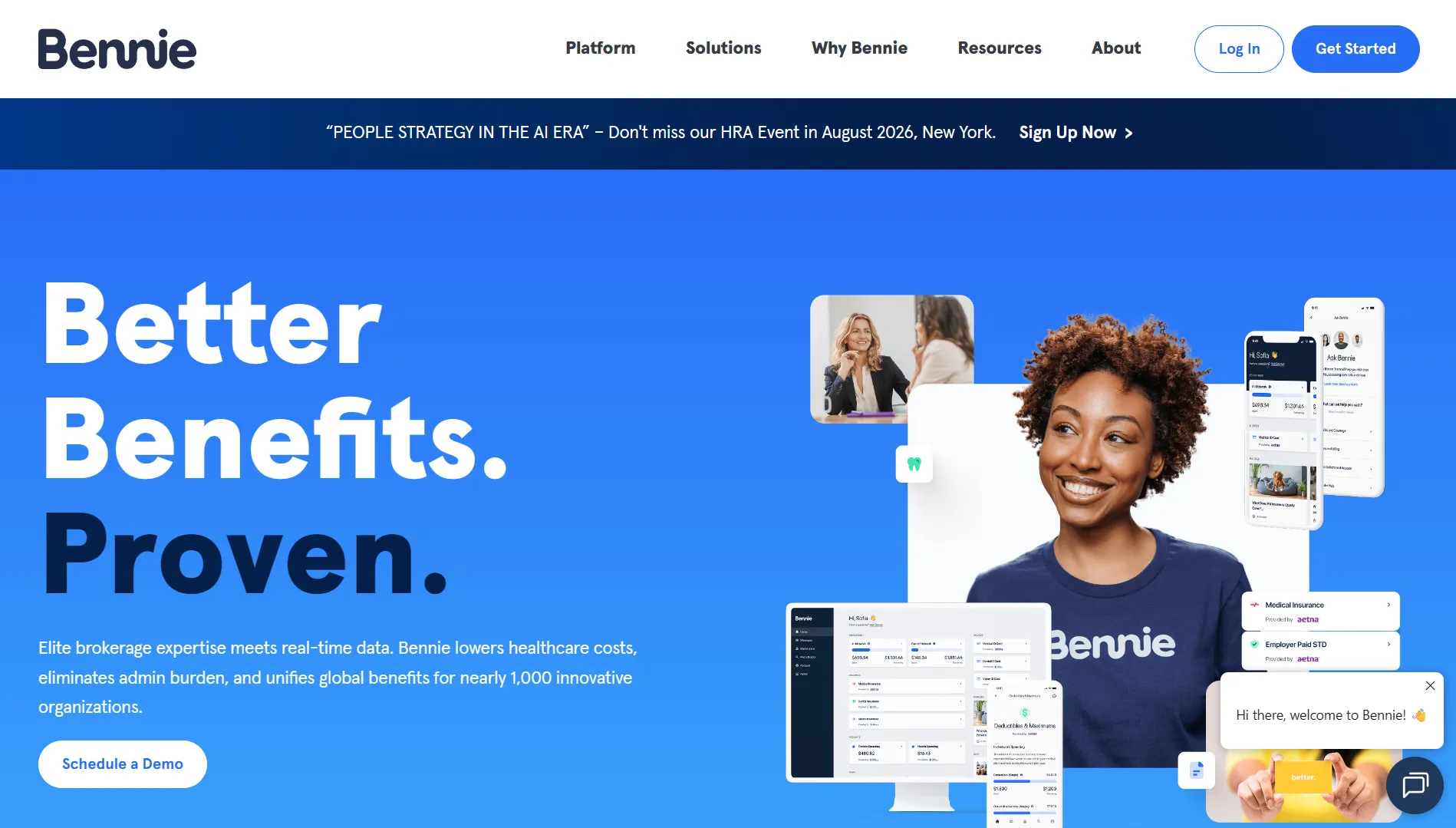
Bennie is a full-service employee benefits broker licensed in all 50 states, with national relationships across major carriers. As stated on its website, it supports close to 1,000 organizations and roughly 150,000 members.
Bennie reports a +76 NPS and a 10% average renewal saving across clients last year. It is paid through carrier commissions, and its ROI calculator states that employers pay the same as they pay their current broker.
Key Features
Ask Bennie
Ask Bennie is a team of benefits specialists reachable through the app. They resolve claims, find in-network providers, and handle carrier disputes directly with employees. Bennie says the service saves 52 minutes per employee inquiry and reports a 98% employee satisfaction rate.
Bennie Insights
Insights benchmarks your costs and workforce demographics against similar companies. It also provides live views of claims trends and utilization. The stated goal is that finance sees the same data HR does, in real time, rather than waiting for an annual report.
Better Health Plan
Bennie offers its own alternative funding product, positioned as the advantages of self-funding at a lower monthly payment than most fully insured plans. It also runs a dedicated PEO transition service for companies leaving co-employment.
Where Bennie Shines
- Employee support is the core product: The concierge model handles the work that otherwise lands on a founder or office manager.
- Real-time claims visibility: Live utilization and benchmark data, rather than an annual report after decisions are already made.
Where Bennie Falls Short
- Built for mid-sized employers: Bennie describes its clients as small and mid-sized companies, with its consulting page aimed at the mid-sized end, so a 15-person startup may not be the target.
- Less suited to very small groups: A company under 25 employees will find the concierge model priced into a service built for larger teams.
Who Bennie Is Best For
- Employers between roughly 50 and 500 employees where benefits questions are a daily interruption for a small HR function.
- Companies leaving a PEO who want the transition handled as a defined project.
Sequoia: Best for Investor-Backed Companies

Sequoia has been advising and brokering benefits for over 24 years, with a model built around investor-backed companies. It is the only firm here that advises on compensation and benefits together, and it runs its own PEO, Sequoia One, alongside standalone brokerage.
Sequoia sells advisory and brokerage as annual engagements, retainers, or projects.
Key Features
Sequoia OS
Sequoia OS brings benefits, retirement, and well-being programs into a single view, with analytics, benchmarking, and renewal modeling. For a company planning headcount and compensation bands alongside benefits spend, that single view is the argument for buying it.
Compensation and Equity Advisory
Sequoia sells compensation work as a retainer with structured quarterly reporting. Defined engagements cover executive compensation, compensation foundation design, and merit cycle support.
Global Benefits
Sequoia offers benefits program design and oversight tailored to each country a client operates in, delivered through its global network. If you employ people outside the US, this separates Sequoia from the other firms in this article.
Where Sequoia Shines
- Global coverage: Country-level program design, which most brokers serving smaller companies cannot match.
- Investor-side experience: Dedicated services for venture capital and private equity firms and their portfolio companies.
Where Sequoia Falls Short
- Scope exceeds most small companies' needs: A 40-person startup buying benefits alone is paying for services it will not use.
- Breadth over depth on any single line: The model covers compensation, benefits, and global programs together, so a company that only needs medical coverage priced well is buying more than it needs.
Who Sequoia Is Best For
- Series B and later companies with an internal people team and a compensation strategy that needs formal management.
- Companies with employees in multiple countries needing coordinated global benefits.
OneDigital: Best for Advisor-Led Consulting Depth
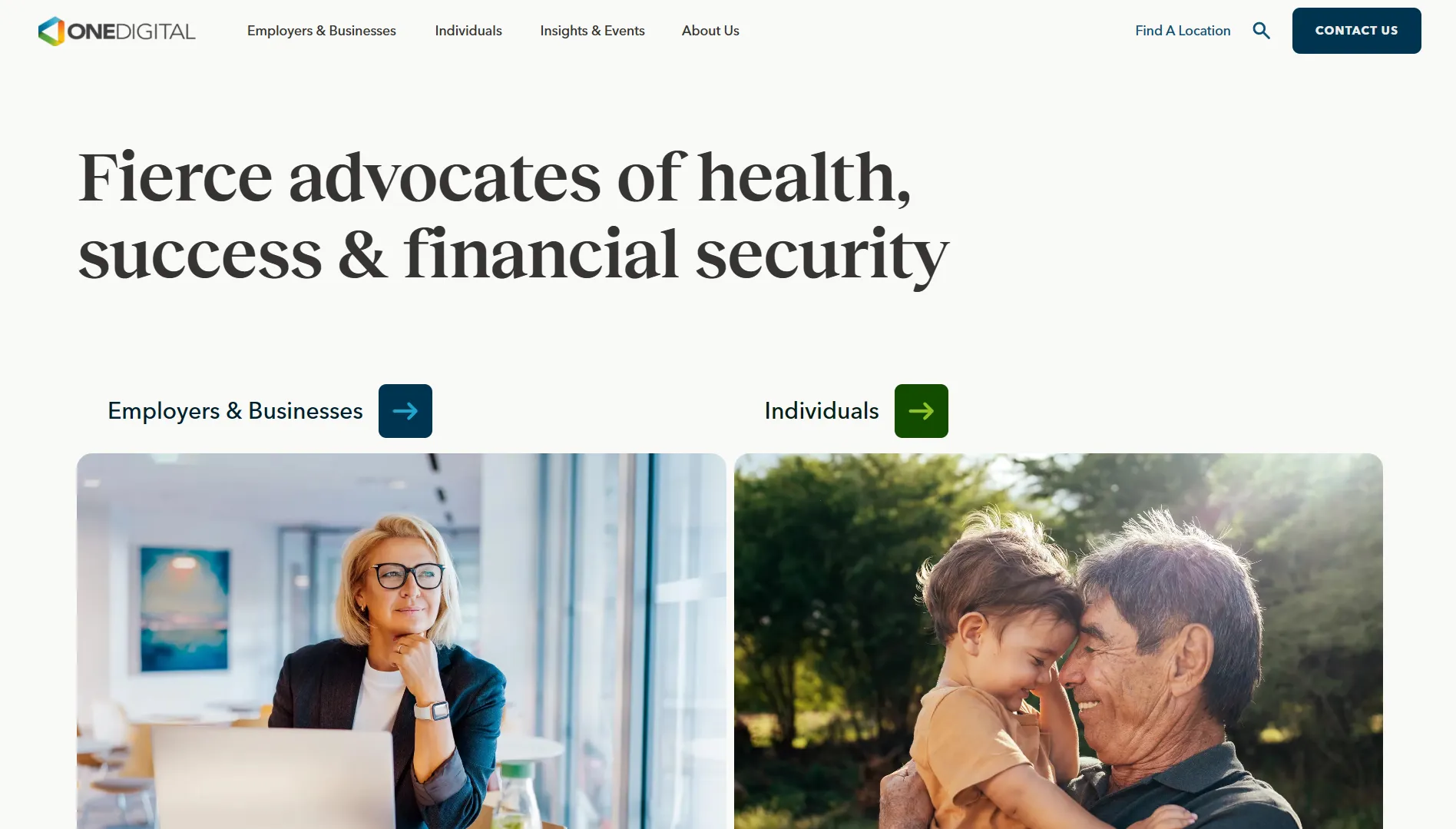
OneDigital is a national advisory firm covering employee benefits, HR, and retirement for employers. Its benefits consulting practice is built around specialist teams rather than software.
It suits employers who want senior consulting depth on funding and pharmacy rather than a platform login. OneDigital is paid either through carrier commissions or a flat consulting fee.
Key Features
Alternative Funding and Captives
OneDigital runs a Self-Funded and Stop Loss Center of Excellence covering funding transitions. It also offers group captive health plans for employers wanting more control over spend without full self-insurance.
Pharmacy Consulting
A dedicated pharmacy practice handles GLP-1 oversight, specialty carve-outs, and independent analysis.
Benefits Analytics and Compliance
OneDigital's analytics platform identifies cost drivers and produces board-level reporting. Its compliance team covers ERISA, the Family and Medical Leave Act (FMLA), and COBRA continuation coverage.
It also offers an Individual Coverage Health Reimbursement Arrangement (ICHRA) framework for employers moving to a fixed contribution model.
Where OneDigital Shines
- Specialist depth: Pharmacy, captives, stop loss, and compliance run as dedicated practices rather than one generalist's side skill.
- Funding transition support: A defined practice for employers moving off fully insured plans.
Where OneDigital Falls Short
- Experience varies by team: With a national footprint and an active acquisition program, your outcome depends heavily on the office you are assigned.
- Less software than the others: The offering is advisor-led, so employers wanting a modern platform will find less here.
Who OneDigital Is Best For
- Employers who value in-person advisory and want a named consultant rather than a platform.
- Companies with complex pharmacy spend or an interest in captive funding.
See Your Benefits Risk Score With Ignition
Your carrier already knows how risky your workforce is. It calculated that score before it sent your renewal, and it priced you accordingly, and it has never shown you the number.
That information gap is the problem. The market audits and the funding structures in this article all exist to close it.
Ignition pulls that score, benchmarks your current spend against companies of your size, stage, and geography, and takes the whole picture to the full market. Everything runs in 14 to 21 days at no fee to the employer.
If your setup is already priced well, you will be told that on the call.
FAQs
What type of insurance is best for a small business?
Group health insurance is the foundation, usually paired with dental, vision, life, and disability. The more consequential question is funding structure rather than product type. Fully insured is the default for small groups. Level-funded plans return unused premium to the employer at year end and often price better for younger, healthier workforces.
What is the best health insurance for a small business?
There is no single answer. Carrier quality varies by state and network, so the right plan for a company in Arizona differs from one in New York. Take your census to multiple carriers, compare on total cost rather than premium alone, and check network adequacy against where your employees actually live. The plan that wins that comparison is your best plan.
Is a broker better than an insurance company?
Usually, yes. Carrier commissions are built into the premium whether or not you use a broker, so buying direct rarely earns you a lower price. A broker compares carriers, handles enrollment and claims escalation, and manages compliance. The value depends on whether they run a genuine market process, which is why you should ask about audit scope before appointing anyone.


_%20Which%20One%20Wins%20for%20Your%20Team_.webp)

![How to Reduce Small Business Health Insurance Costs [2026]](https://cdn.prod.website-files.com/69f22330e53a32bb7629af15/6aa04b2f5dbdf3dc6b28b351_How%20to%20Reduce%20Small%20Business%20Health%20Insurance%20Costs%20%5B2026%5D%20(1).webp)




.webp)



.webp)

.webp)









.webp)





.webp)








.webp)




.png)