.svg)

.svg)


.webp)

In April I wrote that every year for five years, I got robbed.
By a system designed to take advantage of business leaders too busy building their companies to notice — one I never bothered to understand myself. I called it getting robbed in broad daylight, and I expected some polite agreement and a few shares.
What I got instead were founders telling me the same story. Different companies, different states, but the same year-over-year increase nobody could explain.
There's a version of every founder who says health benefits are handled. I was that founder for five years at Plated as we scaled to over 1,000 employees. Our benefits broker never once shopped our plan or showed us our claims data, and we overpaid by over $4M without knowing it. Now I'm building Ignition so other founders don't repeat my mistakes.
What I said I would build
A week later I wrote about the brokerage I actually needed and couldn't find. Four commitments that should be the standard in this industry and somehow aren't.
- Show clients how their carrier is already scoring their risk behind the scenes.
- Keep no preferred carriers, and run a full market audit at every renewal.
- Start the renewal 120 days out, because deadline pressure is a leverage tool used against the buyer.
- And think about benefits the way a good CFO thinks about a cap table: not just this year's cost, but what you can do now to keep it from getting more expensive later.
I made a promise. Here is what happened next.
Today I'm proud to share that Ignition Benefits is backed by Y Combinator.
I said I was going to build the brokerage I actually needed. Now I can show you what that looks like.
What five months of building actually produced
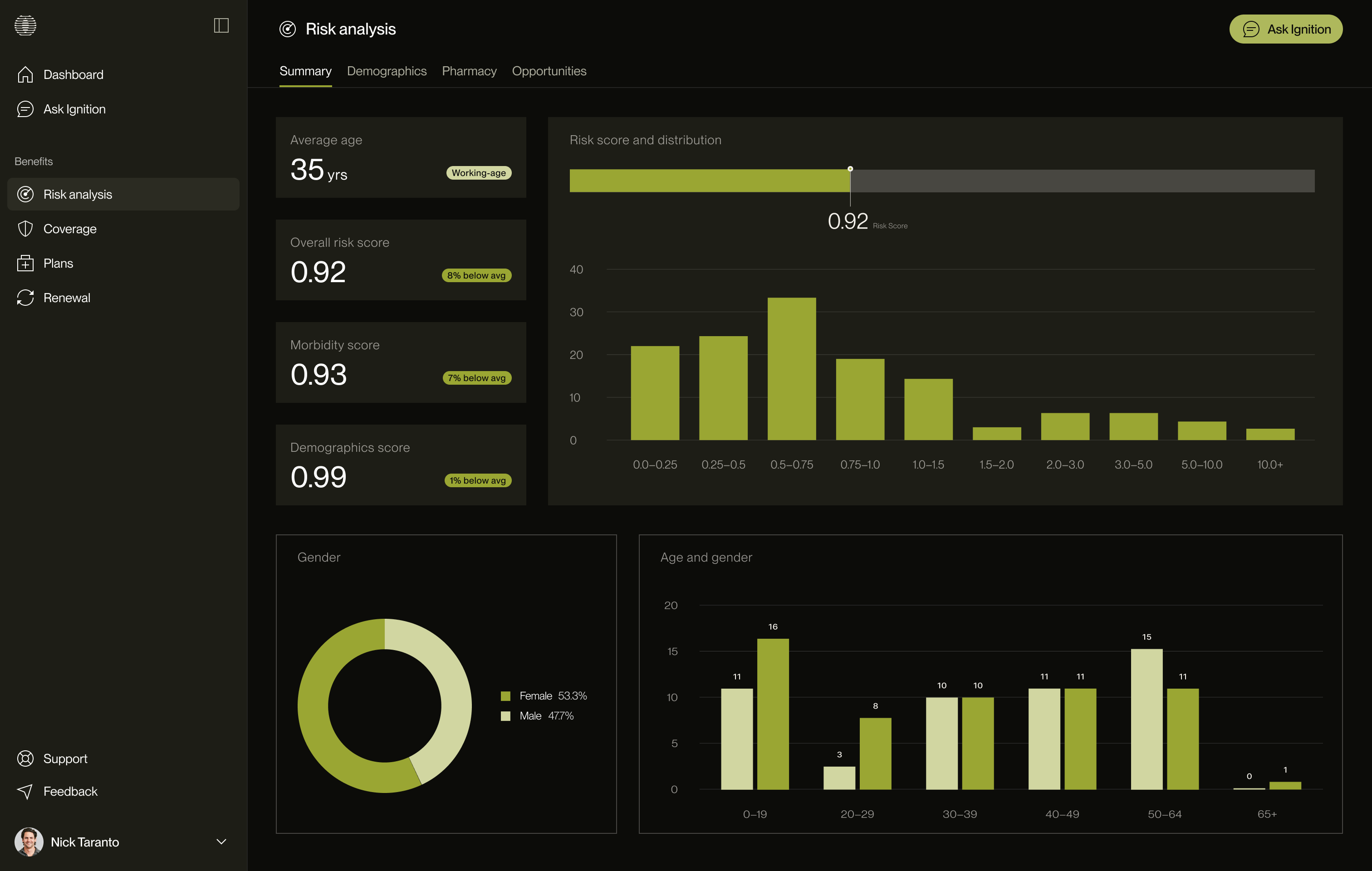
You can now see your workforce the way the carrier does.
Ignition analyzes the health and risk data carriers use to price your plan, so you can see what's actually driving your costs.
Health risk analysis is not a service someone performs for you once a year. It is a screen you open.
Projected refund, savings to date, your risk score, surplus tracker. One view.
Your claims history and workforce demographics, the same inputs the carrier uses, are broken into age mix, claims trend, plan design, and enrollment.
It answers a question almost no employer gets to ask: does my rate actually reflect my workforce's risk, or is someone else's risk hiding in my number?
Rate attribution works the same way. When your renewal moves, you see why it moved: trend, age drift, enrollment mix, in plain English rather than carrier-speak.
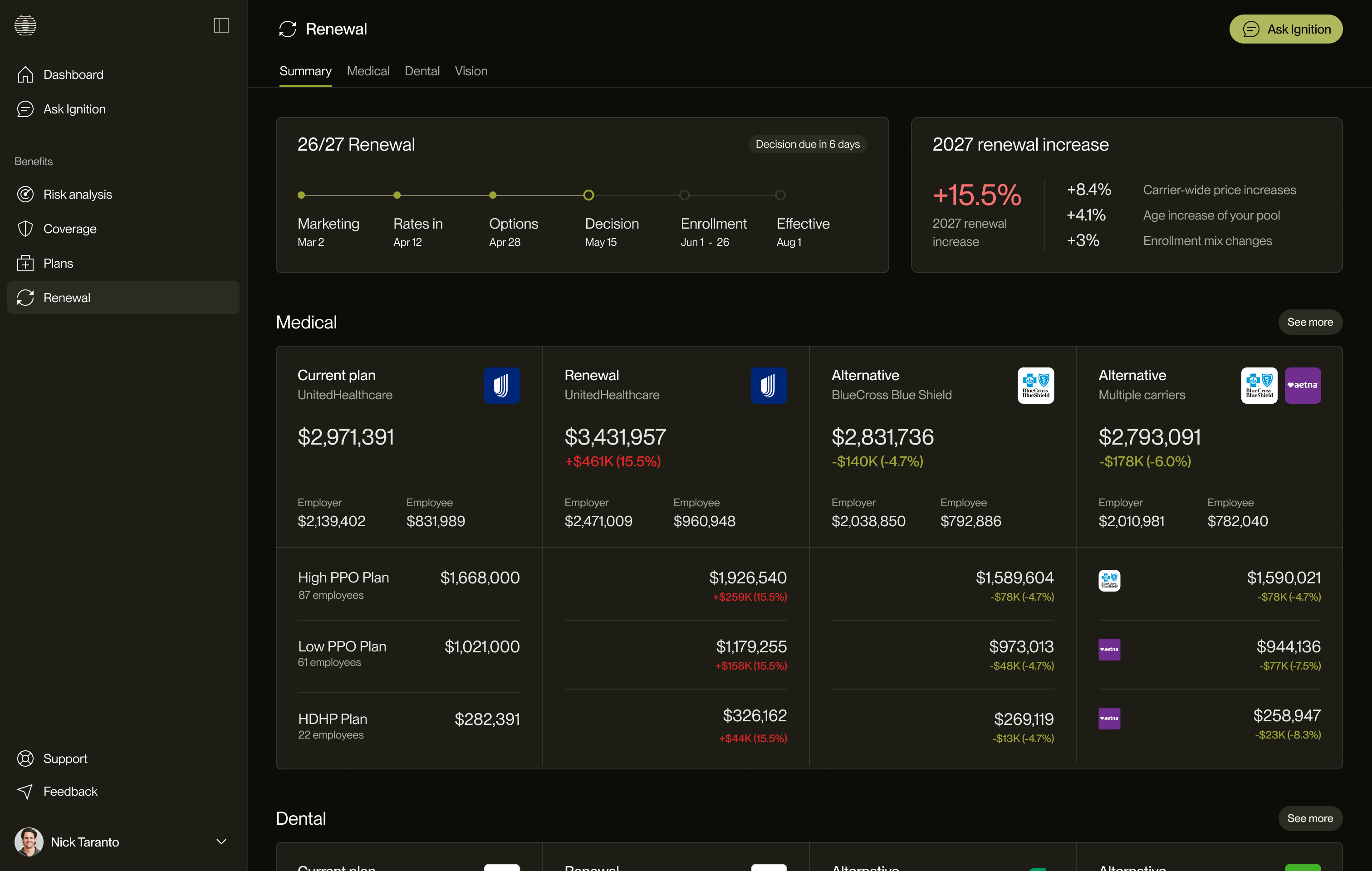
You get licensed experts + AI interventions in your corner
This is the part I'd get wrong if I were reading about us from the outside.
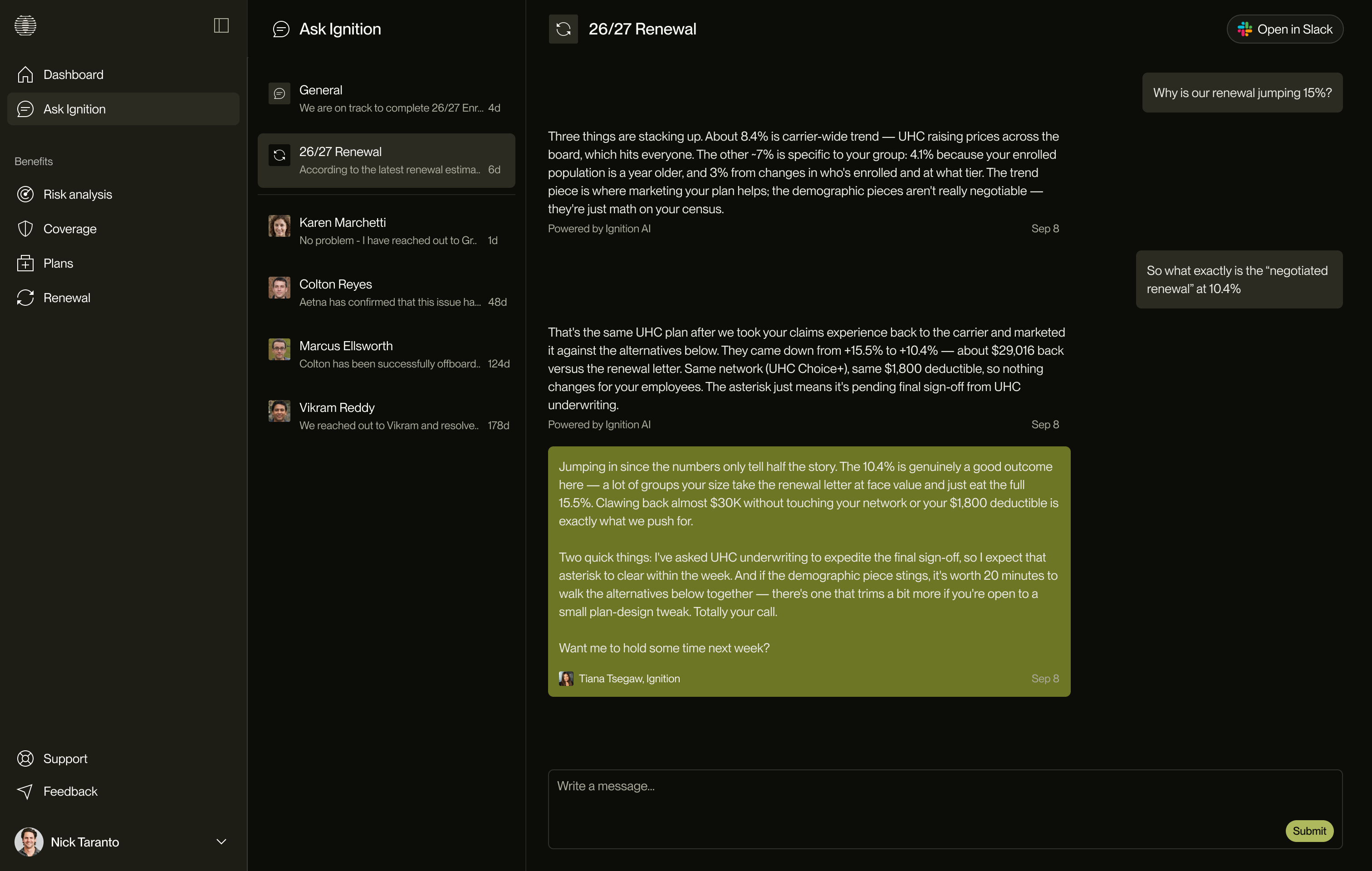
Ignition Intelligence answers questions about your risk profile, renewal, and enrollment status, and surfaces spend projections and Rx insights before you have to go looking for them. Useful. But the same technology is already processing submissions and moving plans forward behind the scenes, catching missed deadlines and incomplete submissions before they turn into problems.
The traditional 8 to 12 week benefits process is a thing of the past.
Most of those weeks were dead time anyway. Waiting on a census, waiting on carrier quotes, or waiting for someone to get to your file.
Nobody in that chain was in a hurry except you.
None of that removes the person. Our licensed experts still compare the plans, take your renewal to market, and walk you through the options. The AI surfaces what to look at and answers questions in context, so nothing sits in a black box waiting for someone to explain it to you.
I am super excited about this intelligence layer. I believe the American health insurance industry is shrouded in acronyms and shadows intentionally to add complexity where it isn't needed. Ignition Intelligence takes the complex and makes it understandable.
You don't have to change your systems.
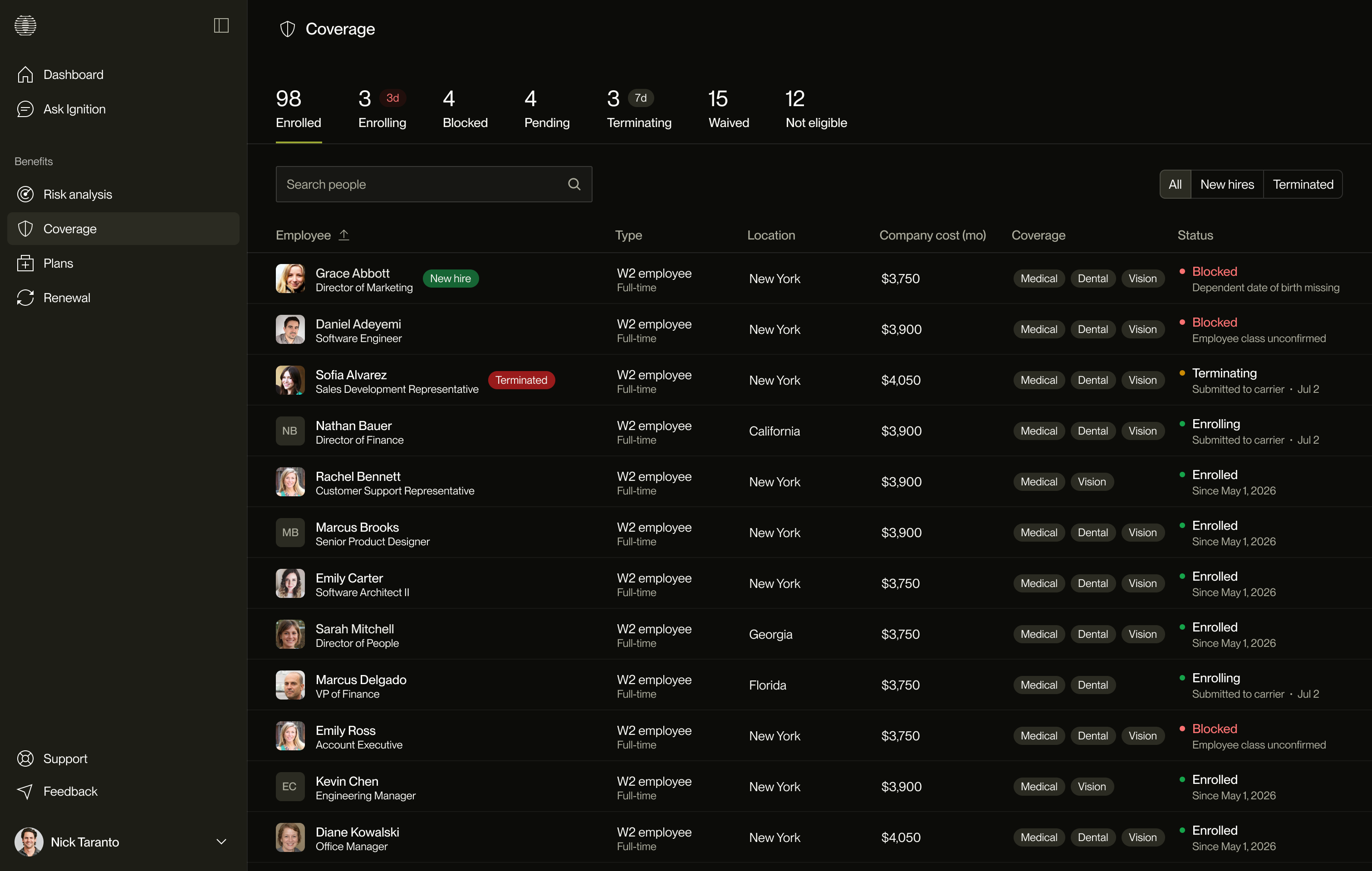
Ignition works around the systems the company already uses, rather than making the employer adopt another stack.
Enrollment status, carriers, and your employee roster live in one place as the system of record, so elections, deductions, and employee data stay in sync automatically. New hires, terminations, and employment changes flow through without anyone re-entering anything.
A full market audit at every renewal is a nice thing to say and an expensive thing to actually do for every client, every year. That only works if the analysis runs itself.
What’s working
Light Labs is the one I think about. Their renewal came in at a 21% increase. They had already signed off on it. Done deal. Moved on.
We reopened it. That 21% increase became an 8% decrease, with better coverage across the board. $113,115 back on the P&L for a 25-person team.
AWM Capital ran their 2026 renewal through Ignition and cut 22% off their initial increase.
$156,914 a year, and they added Mayo Clinic access in the process. Forty-four employees. The entire thing took two 15-minute calls.
In April I estimated the average 100-person company was overpaying somewhere between $180,000 and $360,000 a year. That was a projection built off a commission structure and a ProPublica investigation.
The estimate was a projection. These are real results.
If you multiply these savings across the approximately 500,000 American small businesses that we estimate are being taken advantage of, this turns into over $50 BILLION of savings across the economy. Every year. Our mission is to build transparency, intelligence, and actionable efficiency into fixing this.
What this changes
The goal was never to build a better way to explain benefits. It was to make the experience of buying them better.
A smaller company shouldn't have to accept a worse renewal because nobody has the time to dig into it. It shouldn't have to take its broker's word for what the market looks like. And it shouldn't have to wait until 30 days before renewal to start asking questions.
That's what we're changing.
The analysis happens earlier. The market gets checked. The employer sees what is driving the cost. A 40-person company can now get the same level of attention that used to require 500 employees.
The 120-day renewal isn't a special service for our biggest clients. It's how we work.
What doesn't change
No cost to you
It still costs you nothing. No fee, ever. We analyze your data, identify opportunities, and let you decide what happens next.
We still have no preferred carriers. We still run the full market at every renewal, not the options that pay us most.
And we still tell you what we make on your account, in writing, without being asked. You have had the legal right to demand that from any broker since 2021. Almost nobody does.
Being backed by good investors does not change who we work for. It changes how many companies we can work for.
What’s next for you
If you are the founder who says benefits are handled, this one is for you. I was you for five years. It cost me over $4M and I never once asked my broker how they got paid.
It wasn't carelessness. It was being a founder. There was a product launch and a board meeting and forty other things that felt more urgent. The system is built for exactly that kind of busy.
So here is the smallest possible next step. Book a demo. Take just a few minutes, no cost, no commitment. You can finally have the transparency you need to push back.
Let us show you the modern way to buy health insurance for your people.


_%20Which%20One%20Wins%20for%20Your%20Team_.webp)

![How to Reduce Small Business Health Insurance Costs [2026]](https://cdn.prod.website-files.com/69f22330e53a32bb7629af15/6aa04b2f5dbdf3dc6b28b351_How%20to%20Reduce%20Small%20Business%20Health%20Insurance%20Costs%20%5B2026%5D%20(1).webp)
.webp)




.webp)



.webp)

.webp)









.webp)





.webp)








.webp)




.png)

