.svg)

.svg)


.webp)

- Nava Benefits is a modern brokerage that combines dedicated benefits support with its Nava HQ app, which helps HR teams manage renewals, compliance, billing, enrollment, and employee support.
- Nava’s main strengths are responsive, hands-on support, collaborative benefits planning, less work for HR teams, and access to an HR peer community (Change Agents).
- Nava is better suited to companies with established HR teams and those that aren’t using a Professional Employer Organization (PEO). Some customers also report slower support at times, changes to their account contacts, and gaps in the app’s features.
- For founder-led companies with up to 200 employees, Ignition Benefits is a better fit. It compares different carriers and funding structures at renewal, helps companies leaving a PEO, and handles routine benefits questions and enrollment updates through AI and advisory support.
Nava Benefits is a licensed benefits brokerage with a 4.8 out of 5 G2 rating. Its website says it saves HR teams 40+ hours a month and has earned a 90 Net Promoter Score (NPS) from clients.
But ratings and marketing claims only tell you so much. This Nava Benefits review breaks down its features, pricing, pros and cons, and customer feedback so you can decide whether it’s the right broker for your company.
We’ll also look at when a founder-first brokerage like Ignition Benefits could make more sense for your company. Here's how the two compare:
Nava Benefits: A Quick Overview
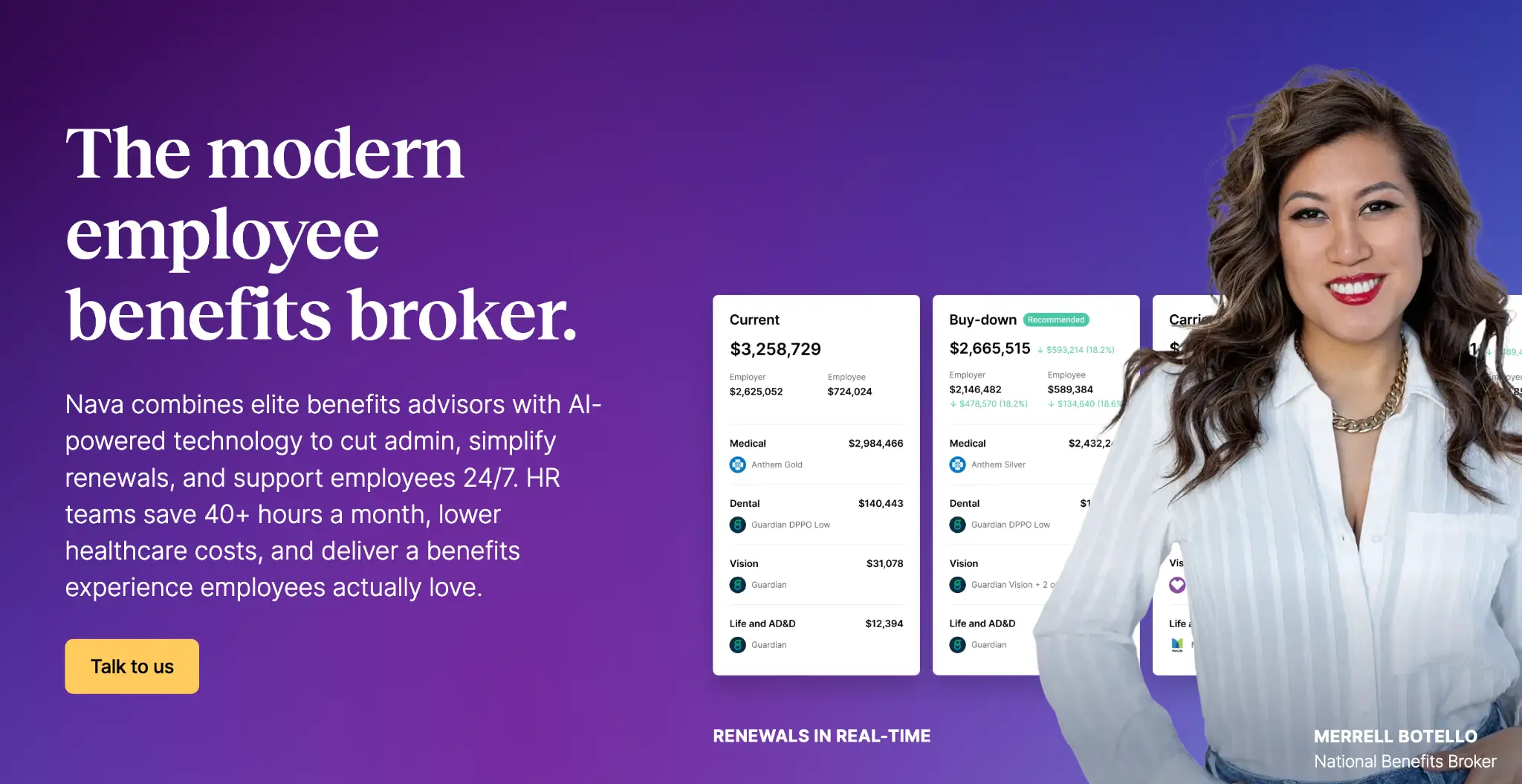
Nava Benefits is a modern employee benefits brokerage recently acquired by Alliant Insurance Services. It pairs licensed, experienced benefits advisors with Nava HQ, its AI-powered app for HR teams and the employees and families they support. Nava provides benefits strategy, carrier negotiations, renewal support, compliance, automatic bill audits, and benchmarking.
Nava also specializes in alternative health plan strategies, including self-funding, captives, and Pharmacy Benefit Manager (PBM) reviews.
Its platform is certified under System and Organization Controls 2 (SOC 2) Type 2 and compliant with the Health Insurance Portability and Accountability Act (HIPAA), two standards for protecting sensitive employee health information.
Who Is Nava Benefits Best For?
Nava Benefits is a strong fit for:
- Mid-sized and large companies with in-house HR: Nava works alongside existing HR teams to handle enrollment, benefits administration, compliance, and vendor management. This gives HR more time to focus on broader benefits strategy and employee needs.
- Companies focused on employee experience: Nava HQ gives employees access to digital ID cards, provider search, and 24/7 support from AI and human advocates. Nava reports a 97% member satisfaction rating on its website.
Nava Benefits Key Features
Nava combines benefits consulting with tech software to support HR teams and employees. Its three main features include:
1. Nava HQ for HR Teams
Nava HQ gives HR teams a central place to manage renewals, plan documents, compliance, benchmarking, and employee communications. Its AI assistant also answers benefits questions and helps draft messages for employees.
One of its standout features is real-time renewal modeling. HR can test different plan designs and employee contribution levels within minutes, then share those scenarios with leadership.
The platform also automates billing and enrollment audits, helping HR spot discrepancies between carrier invoices and employee enrollment records.
2. Nava HQ for Employees and Families
The Nava Benefits app gives employees and their families a single place to manage their coverage. Medical, dental, vision, and other health benefits are all available through one benefits hub.
Employees can access digital ID cards for their family, search for in-network providers, and track their deductible and out-of-pocket maximum in real time. During open enrollment, the app also provides plan decision support to help employees compare their options based on their needs.
Employees have 24/7 access to AI and human benefits advocates who help with carrier issues, medical bill reviews, and other benefits questions.
3. Dedicated Support
Each Nava client gets a dedicated consultant, client manager, and analyst. Nava says the same team stays with the account over time, giving clients consistent support as their benefits needs evolve.
The team takes care of much of the administrative work that typically falls to HR, including open enrollment, benefits administration setup, Human Resources Information System (HRIS) support, implementation, billing audits, and more.
When renewal comes around, the consultant also reviews alternative funding strategies, such as self-funding and captives, and conducts PBM reviews.
Nava Benefits Pricing
Nava's website says it's paid through either a standard carrier commission or a flat fee. The Nava HQ app is included in the brokerage fee, so there’s no separate software license or per-user charge.
Contact Nava’s team to get a customized quote.
Nava Benefits Positives
- Responsive, hands-on support: G2 reviewers frequently praise Nava for its quick responses and hands-on support with carrier and billing issues.
- Collaborative benefits planning: Nava works with clients to build their benefits package and explains the reasoning behind its recommendations.
- Less work for HR: Employees can access digital ID cards and 24/7 support, reducing the number of routine benefits questions HR has to answer.
- Access to an HR peer community: Nava runs Change Agents, an HR community on Slack that offers webinars, peer-led roundtables, virtual and in-person meetups, and access to community advisors who are HR leaders at established companies.
Nava Benefits Negatives
- Skews toward companies with HR infrastructure: Nava is a strong candidate for companies with a dedicated HR team. Founder-led companies without HR staff will find Ignition Benefits a better fit for their stage.
- Less focus on PEO lift-out: Nava positions itself mainly as a replacement for traditional brokers.
- Occasional slow support and contact changes: Some G2 reviewers report slower support at times and account contacts that changed without a proper introduction.
- App feature gaps: Some reviewers say the app lacks features more mature tools offer, like appointment scheduling.
Customer Reviews
Jessica J. notes, “I appreciate that Nava Benefits is an immediate resource for any employee-facing issues, which is crucial for us to handle things quickly. They are also very responsive to backend issues with our main medical provider or any auxiliary items.
I like their assistance in preparing reports, reconciling, and confirming everything is in order, both for employee-facing and backend processes, which saves us time to focus on our employee programs and other support initiatives.”
One G2 reviewer shares, “There have been times where our designated contacts have changed without notice or explanation. We've also been pointed towards new contacts without proper introductions. This can definitely create an uncomfortable experience, but it's typically a short term feeling.”
Kaylyn R. says, “The NBA app is still new and as a result lacks some features more mature broker tools have, for example the ability to schedule appointments on the app or have app access with cards for dependents.”
Alternative to Nava Benefits: Ignition Benefits
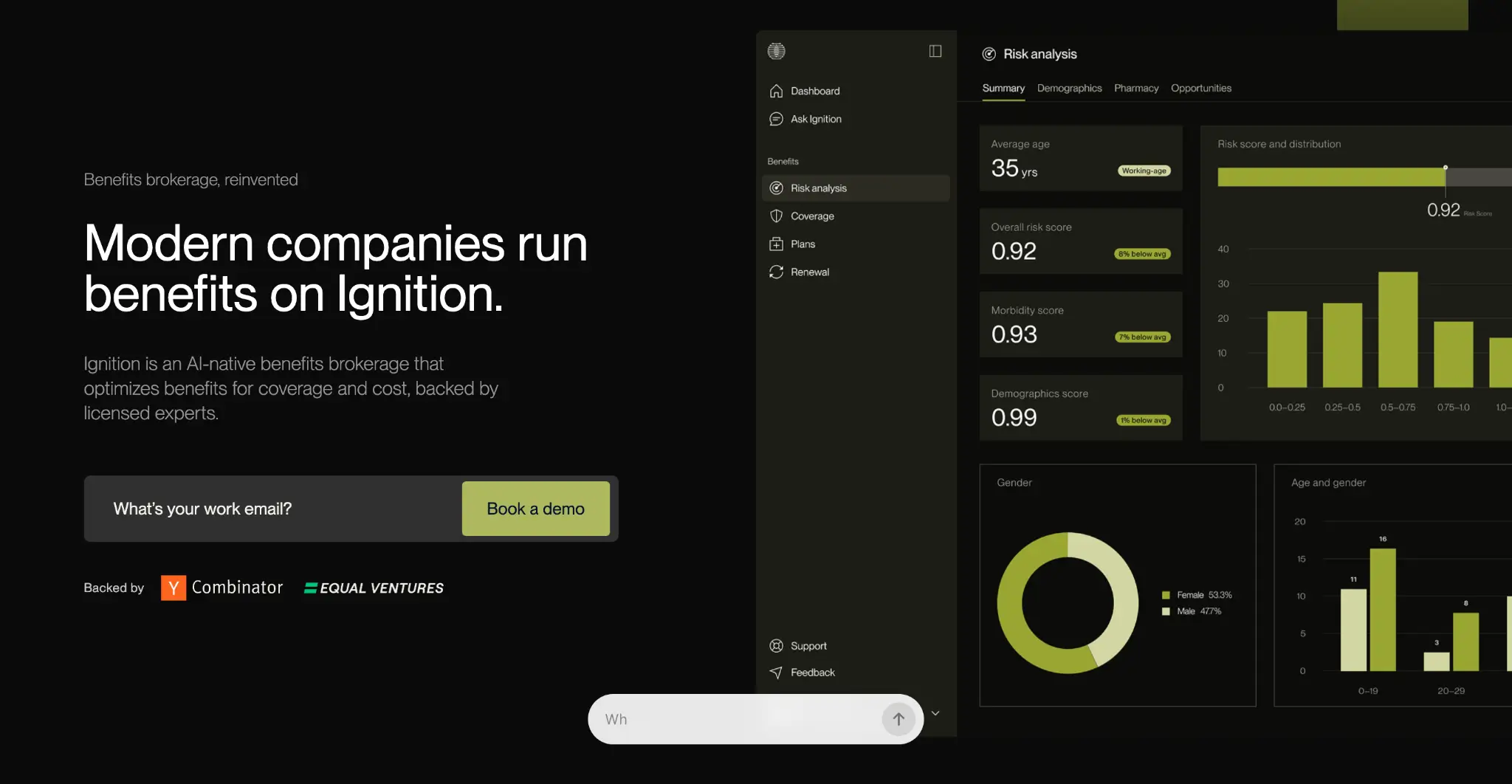
Nava is built for companies with established HR teams and a broad benefits infrastructure. Ignition Benefits takes a more founder-focused approach, working with companies with up to 200 employees that often have fewer internal resources dedicated to benefits.
Ignition Benefits Key Features
Below are Ignition’s key features that help companies find the right coverage at a competitive cost.
1. Health Risk Analysis
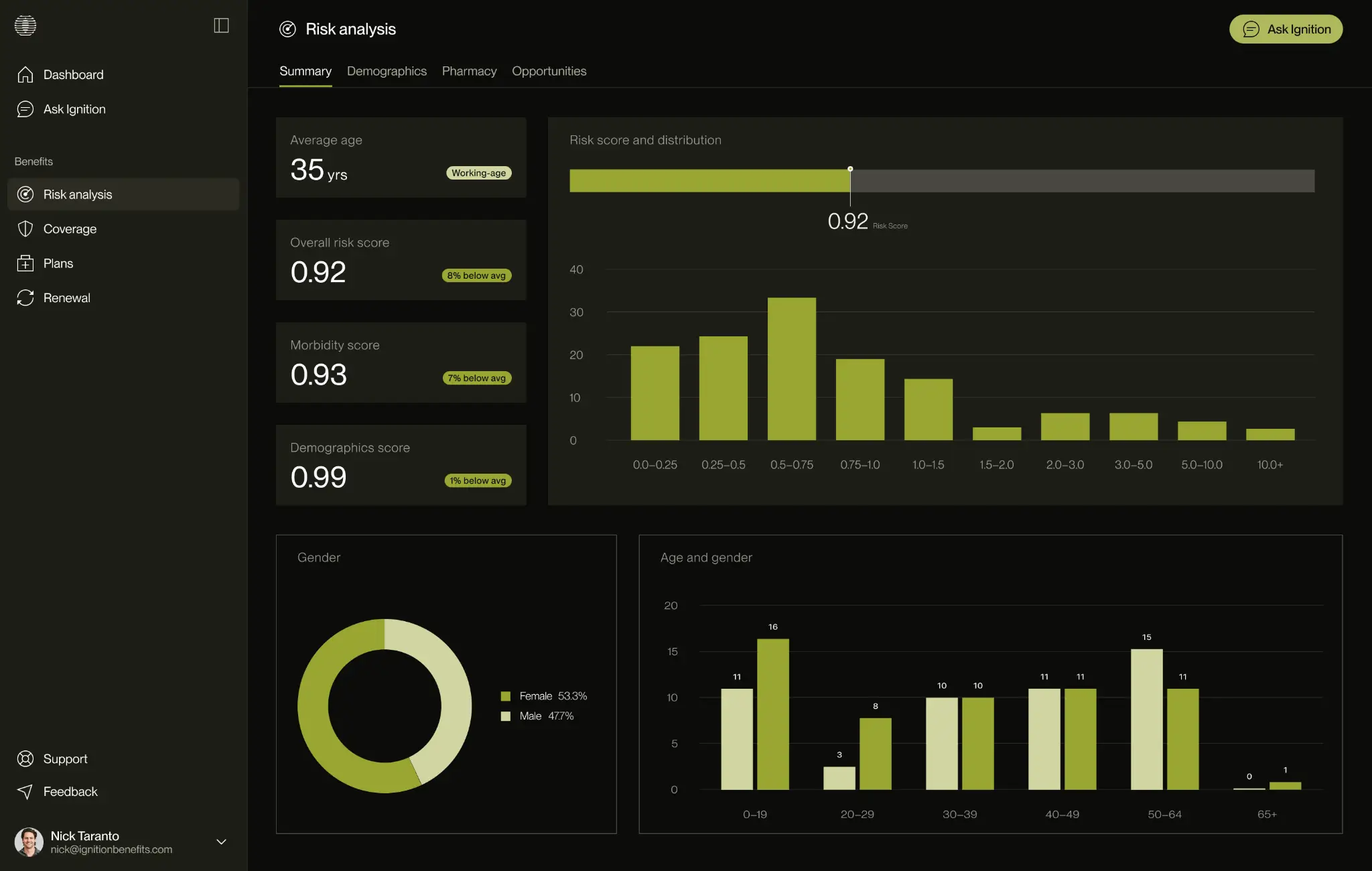
Insurance carriers assess your group’s risk when setting renewal rates, but employers rarely get to see how that assessment affects their pricing.
Ignition’s health risk analysis shows employers what goes into that assessment. It analyzes claims history and workforce data and identifies factors that could affect your rates, such as age mix, claims trends, and plan design.
You can then use that information during renewal discussions. If the analysis shows your group has a lower risk profile than your renewal pricing suggests, Ignition can use that data when negotiating with carriers.
2. Benefits Admin
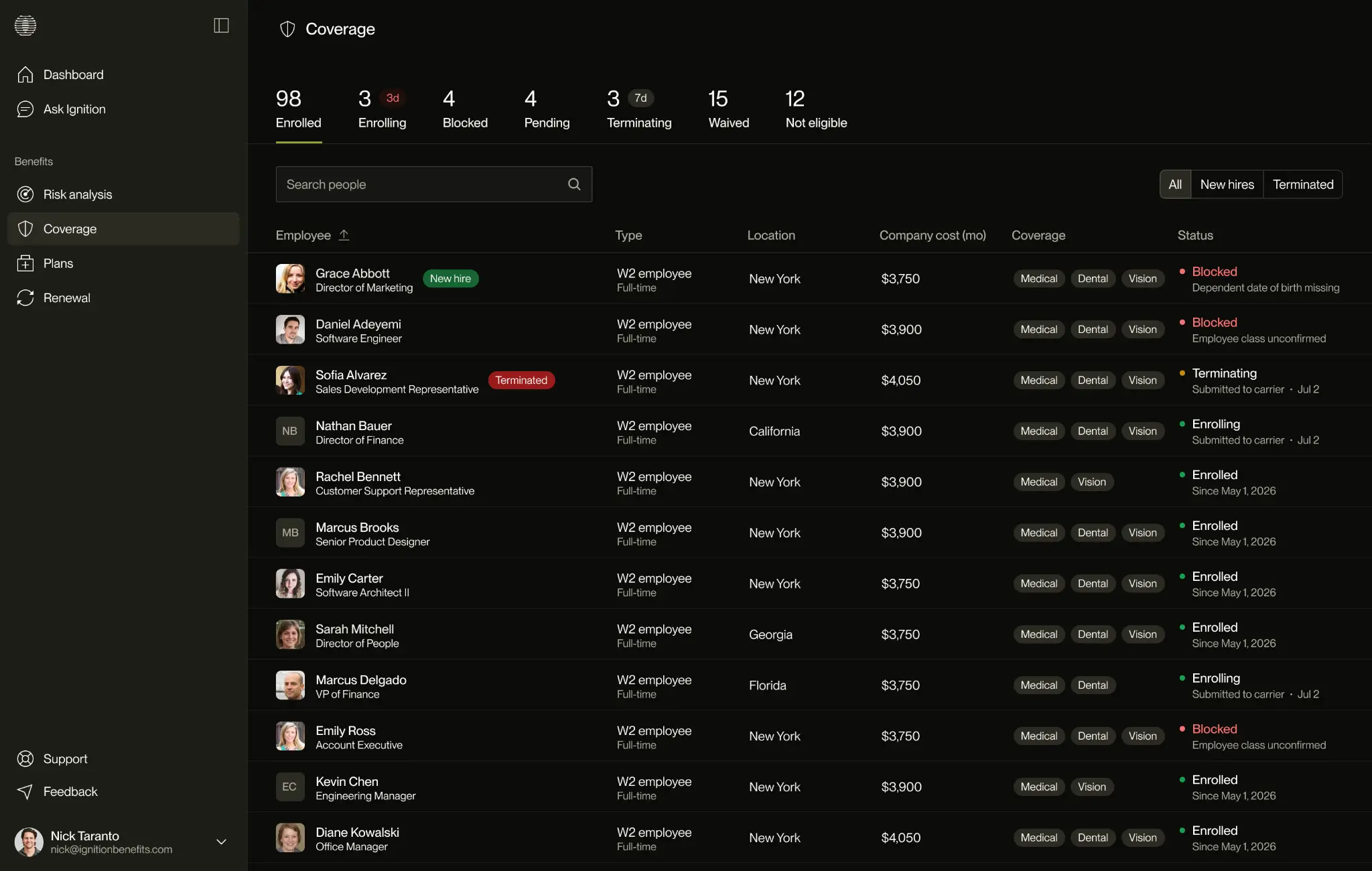
Ignition’s benefits admin brings enrollment, life events, and coverage into one place. You can follow each enrollment through to the carrier and see whether it has been submitted, confirmed, or held up without having to call for an update.
The platform also tracks changes to elections, dependents, and life events, while a per-person roster shows what’s currently in process and which deadlines are approaching.
Ignition pulls data from your existing payroll system, so there’s no need to migrate data or enter it again. It also works alongside your HRIS.
3. Ask Ignition
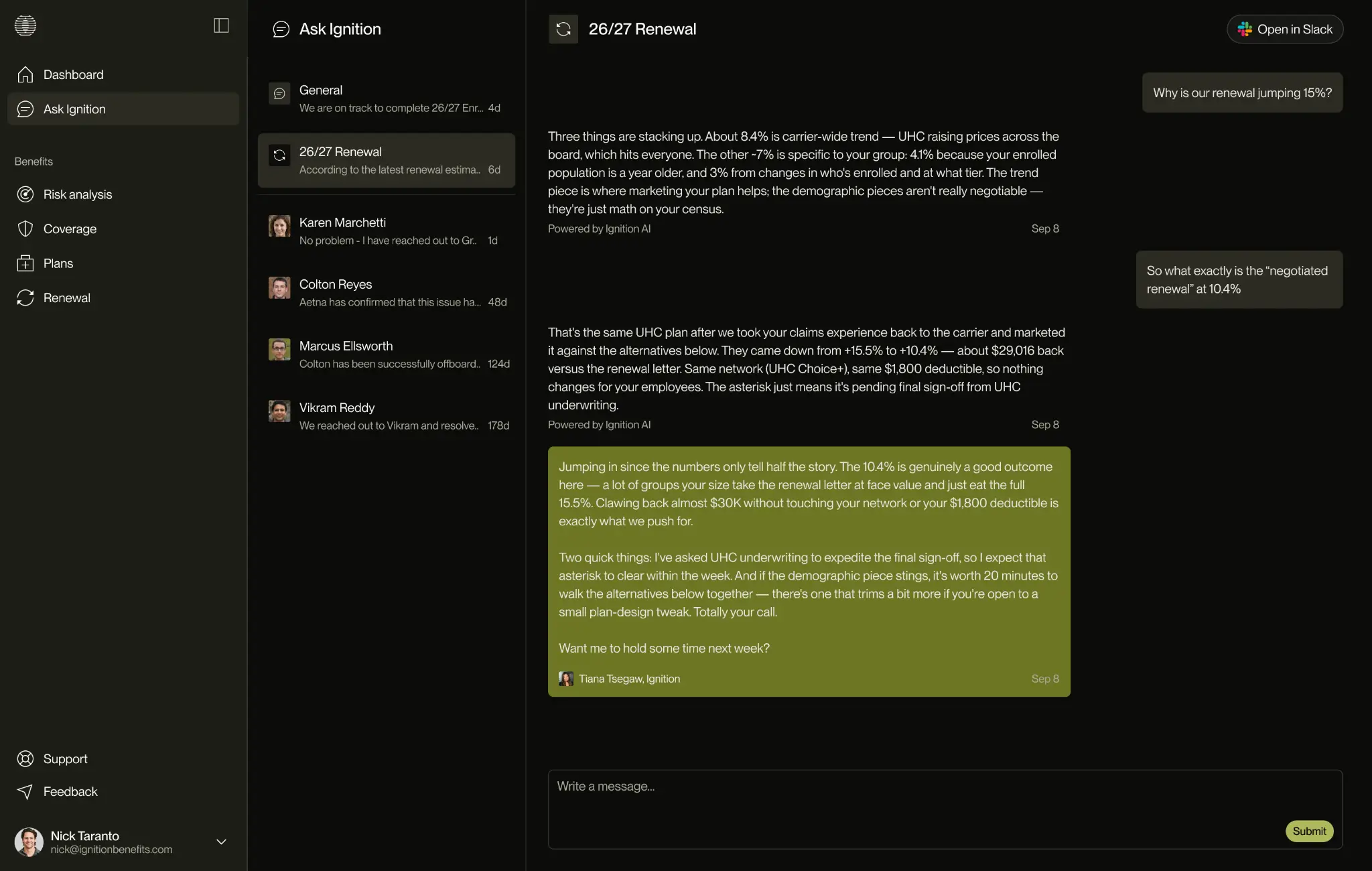
Ask Ignition is an AI assistant that answers benefits questions in Slack, with in-app chat coming next. You can ask about your risk profile, a renewal option, or an enrollment status and get an instant answer.
Answers come from your company's own plan documents. When a question is sensitive or the answer is uncertain, Ask Ignition routes it to a licensed expert.
Behind the scenes, Ignition's AI agents also watch for missed deadlines and incomplete submissions, so they get fixed before they become coverage gaps. A person on the Ignition team makes every final decision.
Ignition Benefits Pricing
Ignition charges no direct fee to the employer. Like most benefits brokers, Ignition is paid through standard carrier commissions.
Where Ignition Benefits Shines
- Full market audit: At every renewal, Ignition compares all carriers and plans against your workforce data. It also assesses alternative funding structures, such as level-funded and self-insured plans, to see whether they could reduce your benefits costs.
- Specialized PEO transitions: Ignition helps companies move from PEO pool pricing to a benefits plan based on their own workforce. It starts by showing you the risk score carriers use to price your group, then takes your benefits to the full market to compare alternatives.
- Less time commitment from founders: Ignition keeps the benefits review to two 15-minute calls: one to share workforce data and another to review the recommendation. This keeps benefits from taking up too much of founders’ time than necessary.
- Greater transparency into your benefits costs: Ignition shows what is driving your premium and compares available options side by side. You get a clearer view of what is driving your costs, what alternatives are available, and how the options compare, so you can make a more informed benefits decision.
Where Ignition Benefits Falls Short
- Less suited to large or global employers: Ignition serves U.S. companies with up to 200 employees. Larger enterprises with formal procurement processes or international teams may need a broker with broader scale and global capabilities.
Ignition Benefits Customer Reviews
Robert McConchie from AWM Capital shares, “We assumed Gusto was getting us a fair deal on benefits. Two short calls with Ignition saved us six figures and got us better coverage than we'd ever had.”
Nick Mares from Light Labs says, “I didn't realize how much money we were leaving on the table until Ignition ran the numbers. We saved $113,000 in year one, on a 25-person team. For a company our size, that makes a big difference.”
Who Ignition Benefits Is Best For
- Founder-led companies with up to 200 employees: You’re making benefits decisions without a mature HR team and want a broker that works directly with you on plan strategy, renewal, and ongoing benefits needs.
- Founders dealing with a steep renewal increase: Your premium is going up by a large margin and you want to know whether the increase reflects your workforce or whether other carriers and funding structures offer better alternatives.
- Companies preparing to leave a PEO: You want to understand how PEO pooled pricing compares with plans priced around your own workforce and see what alternatives are available outside the PEO’s network.
How to Choose a Benefits Broker
The right benefits broker depends on your company’s size, internal HR resources, and what you need from a broker. A founder managing benefits alongside the rest of the business needs a different level of support than a company with a dedicated HR team and a formal benefits function.
When comparing Nava, Ignition, or another broker, focus on three things: how much visibility you get into your pricing, how broadly the broker shops your plan, and how well its process fits your company.
Watch the video below for the detailed framework:
Does the Broker Show You What Your Pricing Is Based On?
Your insurance premium reflects how a carrier evaluates your workforce, including its claims experience, demographics, and plan design. That assessment plays a role in the renewal rate you receive, yet many employers only see the final number.
A broker should be able to explain what is behind that number and show you how your workforce is being evaluated. Ask the broker to walk you through the risk profile behind your last renewal, what changed from the previous year, and how those changes affected your pricing.
Does the Broker Test the Full Market?
Getting a few quotes does not tell you what the broader market looks like. The number of quotes matters, along with what the broker is comparing. A meaningful market review should look across available carriers and consider whether different funding structures could change your plan pricing.
Ask which carriers the broker approached during your last renewal, how many options it compared, and whether it evaluated alternatives such as level-funded or self-funded plans. You should also ask what happened when the broker found a lower-cost or structurally different option and how it compared with your existing plan.
Does the Broker's Process Fit Your Company?
A broker can offer extensive services and still be a poor fit if managing the relationship requires more time than your team has available. This matters especially for founder-led companies where the person making benefits decisions is also running the business.
Before choosing a broker, ask what onboarding involves, how much time you’ll need to spend during renewal, who handles the work between meetings, and whether you need an HR team to manage the relationship. Find out who your day-to-day contact will be and what happens when an issue comes up outside renewal.
FAQs
Is Nava Benefits a Legitimate Insurance Broker?
Yes. Nava Benefits is a licensed employee benefits brokerage. It also has a 4.8 out of 5 rating on G2 based on 60+ reviews.
Does Nava Benefits Replace Your Payroll or HRIS System?
No, Nava is a benefits broker. You’ll need a separate payroll and HRIS system to work alongside it.
Does Nava Benefits Support Employees Based Outside the United States?
Nava Benefits is currently focused on the U.S. market. That could change following Alliant Insurance Services' acquisition of Nava Benefits in August 2026. International benefits will be one of the new capabilities available in the future.
Is Nava Benefits the Right Broker for You?
Nava Benefits is built for mid-sized and large companies with established HR teams that need hands-on benefits administration, employee support, and year-round service.
Ignition works with founder-led companies with up to 200 employees that want more visibility into benefits costs and a simpler renewal process. Clients see their Benefits Risk Score before quotes arrive, get a full market audit across carriers and funding structures, and receive a recommendation within 14 to 21 days.
If you’re a founder or CFO preparing for renewal, book a demo with Ignition Benefits.










_%20Which%20One%20Wins%20for%20Your%20Team_.webp)

![How to Reduce Small Business Health Insurance Costs [2026]](https://cdn.prod.website-files.com/69f22330e53a32bb7629af15/6aa04b2f5dbdf3dc6b28b351_How%20to%20Reduce%20Small%20Business%20Health%20Insurance%20Costs%20%5B2026%5D%20(1).webp)
.webp)




.webp)



.webp)

.webp)









.webp)





.webp)








.webp)




.png)

